Mobility on the Silk Road Beyond Commerce
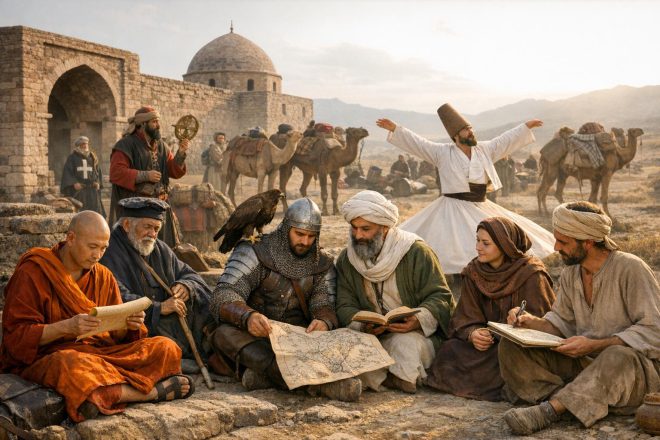
The Silk Road was not solely a network of commercial exchange. It also facilitated the movement of diverse groups whose motives ranged from religion and diplomacy to warfare and intellectual pursuit. These travelers shaped cultural, political, and technological interactions across Eurasia, often more profoundly than merchants themselves. The routes that later historians collectively labeled the “Silk Road” were never a single road but rather a shifting web of corridors linking oasis settlements, imperial capitals, and frontier zones. Across these spaces, mobility was conditioned by ecology, imperial policy, and local intermediaries. The cumulative result was a system in which non-commercial actors played a decisive role in transmitting beliefs, administrative practices, and forms of knowledge across vast distances.
Religious Travelers and Missionaries
Religious figures were among the most influential non-commercial travelers. Buddhist monks moved between the Indian subcontinent, Central Asia, and China, transmitting scriptures, ritual practices, and artistic traditions. Their movement was not incidental but often supported by royal patronage and institutional networks. Monks traveled in search of authoritative texts and lineages, and in doing so, they created corridors of intellectual exchange that paralleled commercial routes.
The accounts of Faxian in the 5th century and Xuanzang in the 7th century demonstrate how deeply these journeys intersected with geography and politics. Xuanzang’s travel narrative, for instance, provides detailed descriptions of Central Asian polities, their economies, and their religious landscapes. His return to Tang China with a large corpus of Sanskrit texts led to major translation projects that reshaped Chinese Buddhism. Translation centers in places such as Dunhuang and Chang’an became sites where linguistic skill, doctrinal debate, and imperial sponsorship converged.
Material culture reflects the same patterns of movement. Cave complexes in Dunhuang, Kizil, and Bamiyan reveal hybrid artistic styles that combine Indian iconography, Persian motifs, and Chinese techniques. These were not passive adaptations but the result of sustained contact facilitated by itinerant religious specialists, artisans, and patrons.
Similar dynamics can be observed in the spread of Christianity. Church of the East communities extended their influence eastward through Central Asia and into Tang China by the 7th century. The so-called Nestorian Stele erected in 781 in Chang’an attests to the presence of Christian communities integrated into the imperial system. These missionaries adapted their terminology and practices to local contexts, using Chinese concepts to describe Christian theology.
Following the expansion of Islamic polities into Central Asia, Islamic scholars and Sufi missionaries traveled along established routes, contributing to the gradual Islamization of the region. Sufi lodges served as nodes of social and spiritual activity, often embedded in trade networks but distinct in purpose. These figures mediated between local customs and broader Islamic intellectual traditions, creating layered forms of religious identity rather than uniform conversion.
Diplomats and Envoys
Political authorities relied heavily on the Silk Road for diplomatic communication. Envoys carried treaties, tribute, and intelligence between empires such as Han China, the Parthian Empire, and later the Byzantine and Sasanian states. These missions required not only endurance but also linguistic skill and cultural awareness, as envoys often navigated multiple jurisdictions and negotiated with intermediaries.
One of the earliest recorded examples is the mission of Zhang Qian in the 2nd century BCE. Sent by the Han court to establish alliances against the Xiongnu, Zhang Qian’s journey extended far beyond its original purpose. His reports introduced the Han elite to the political geography of Central Asia, including the existence of states such as Ferghana and Bactria. This knowledge directly informed Han expansion and the establishment of garrisons along the Hexi Corridor, effectively anchoring Chinese presence in the Silk Road system.
Diplomatic exchanges were frequently embedded in ritualized frameworks. Tribute missions, gift exchanges, and ceremonial receptions constituted a language of power that structured relations between polities. These practices did not necessarily imply subordination in a modern sense but rather signaled participation in a shared diplomatic order. Through these encounters, empires gained indirect awareness of one another, even when direct contact remained limited.
During the medieval period, interactions between the Byzantine Empire, Islamic caliphates, and Central Asian states were similarly mediated through envoys. Intelligence gathering was a central component of these missions. Reports on military capabilities, trade conditions, and internal stability circulated among courts, shaping strategic decisions. Thus, diplomatic mobility along the Silk Road contributed not only to communication but also to geopolitical calculation.
Scholars and Intellectuals
The Silk Road enabled the circulation of knowledge and scientific ideas across Eurasia. Scholars traveled to study astronomy, medicine, mathematics, and philosophy, often seeking centers of learning renowned for their expertise. These movements were facilitated by patronage networks that included rulers, religious institutions, and wealthy benefactors.
Cities such as Samarkand and Baghdad functioned as intellectual hubs where multiple traditions converged. In Baghdad, the Abbasid caliphate sponsored translation movements that brought Greek philosophical works into Arabic, often through intermediaries familiar with Syriac and Persian traditions. These texts were subsequently interpreted, critiqued, and expanded by scholars working within Islamic intellectual frameworks.
The transmission of technologies such as papermaking illustrates how intellectual exchange was intertwined with material practices. Papermaking techniques, originating in China, spread westward following encounters between Chinese and Central Asian populations. By the 8th century, paper production had been established in the Islamic world, significantly lowering the cost of written communication and facilitating the expansion of scholarly activity.
Medical knowledge also traveled along these routes. Texts and practitioners moved between India, Persia, and the Mediterranean, producing composite traditions that integrated herbal remedies, surgical techniques, and theoretical frameworks. Astronomical knowledge circulated in a similar manner, with instruments and observational techniques adapted across regions.
These processes were not unidirectional. Chinese scholars incorporated elements of Central Asian and Indian astronomy, while Islamic scholars engaged with and transformed Greek and Persian knowledge. The result was a dynamic system of exchange in which intellectual authority was continually negotiated.
Soldiers and Imperial Agents
Military presence was a constant feature along the Silk Road. Soldiers, garrisons, and frontier administrators maintained control over key routes and oasis towns. These actors ensured the flow of goods and information by securing passages, collecting taxes, and suppressing local unrest. Without such structures, sustained mobility across long distances would have been significantly more difficult.
Empires such as the Tang dynasty extended their influence into Central Asia through a network of protectorates and alliances. Military colonies were established to support logistical operations and to reinforce imperial authority. These installations often evolved into centers of cultural interaction, where soldiers, officials, and local populations exchanged practices and beliefs.
The Mongol Empire represents a particularly significant phase in the history of Silk Road mobility. By unifying a vast territory under a relatively stable political framework, the Mongols facilitated unprecedented levels of movement. The system known as the yam, a network of relay stations, allowed envoys and officials to travel efficiently across long distances. Passports or safe-conduct documents issued by Mongol authorities granted protection and access to resources.
This environment enabled figures such as William of Rubruck and Giovanni da Pian del Carpine to travel deep into Central Asia and the Mongol heartlands. Their accounts provide detailed observations of Mongol administrative systems, religious diversity, and social organization. While the Mongol Empire was sustained through military conquest, its governance created conditions that supported a wide range of non-commercial mobility.
Adventurers and Observers
Some travelers moved for reasons that do not fit neatly into institutional categories. Individuals such as Marco Polo documented their journeys, offering descriptions of governance, infrastructure, and daily life across Eurasia. Although questions remain regarding the accuracy of certain elements in these accounts, their impact on later perceptions of Asia in Europe was substantial.
Other observers included artisans, translators, and intermediaries who operated between cultures. These individuals often possessed practical skills that made them valuable to multiple communities. Translators, in particular, played a crucial role in facilitating communication among diverse linguistic groups. Their work extended beyond literal translation to include cultural interpretation, making them indispensable in diplomatic, commercial, and religious contexts.
Artisans contributed to the diffusion of techniques and styles. Textile production, metalwork, and ceramics exhibit patterns of influence that reflect sustained interaction among regions. These exchanges were rarely controlled by centralized authorities; instead, they emerged from the cumulative effect of individual movements and local collaborations.
Infrastructures of Movement
Mobility on the Silk Road depended on physical and institutional infrastructures. Caravanserais provided lodging and security for travelers, while water management systems sustained life in arid environments. Mountain passes and desert routes required specialized knowledge, often held by local guides and communities.
Imperial policies also shaped movement. Taxation regimes, border controls, and systems of protection influenced who could travel and under what conditions. Periods of political fragmentation often increased risks, while phases of consolidation facilitated greater mobility. The balance between local autonomy and imperial oversight was a defining feature of the Silk Road system.
Cultural Translation and Hybridization
As individuals moved across regions, they engaged in processes of cultural translation. Ideas were not simply transmitted intact; they were reinterpreted and adapted to new contexts. Religious doctrines were expressed in local languages and symbols, political concepts were modified to fit existing institutions, and artistic styles were reshaped through exposure to different traditions.
This process produced hybrid forms that cannot be attributed to a single origin. Central Asian societies, in particular, functioned as zones of synthesis where Iranian, Turkic, Indian, and Chinese elements intersected. The resulting cultural landscapes were characterized by diversity and fluidity rather than uniformity.
Continuities in the Modern Context
In discussions of the contemporary “New Silk Road”, particularly China’s Belt and Road Initiative, similar patterns of mobility reappear in altered form. Engineers, political representatives, development specialists, and cultural envoys now traverse many of the same regions. While the technological and economic context differs significantly from that of earlier periods, the underlying geopolitical logic shows notable continuity.
Modern infrastructure projects create corridors that facilitate not only trade but also the movement of expertise and influence. Educational exchanges, cultural programs, and diplomatic engagements accompany investments in transportation and energy networks. These activities echo earlier forms of mobility in which non-commercial actors played a central role.
At the same time, contemporary conditions introduce new complexities. State sovereignty, international law, and global financial systems shape the terms of engagement. Digital communication reduces the need for physical travel in some domains while increasing coordination across distances. Nonetheless, the movement of individuals remains essential to the operation of large-scale transregional initiatives.
Geopolitical Implications
The historical Silk Road demonstrates that long-distance connectivity is never purely economic. It is embedded in systems of power, knowledge, and cultural exchange. Non-commercial actors often serve as agents of transformation, carrying ideas and practices that reshape societies.
In the modern context, similar dynamics are evident. The movement of specialists, diplomats, and cultural representatives contributes to the projection of influence and the negotiation of interests. Competing visions of connectivity reflect broader geopolitical tensions, with different states seeking to shape the rules and norms governing transregional interaction.
Understanding the Silk Road as a space of multifaceted mobility allows for a more nuanced interpretation of both past and present. It highlights the role of individuals and institutions beyond commerce, emphasizing the interconnectedness of cultural, political, and intellectual life across Eurasia.
Conclusion
The Silk Road was sustained not only by the exchange of goods but also by the movement of people driven by diverse motivations. Religious travelers, diplomats, scholars, soldiers, and observers collectively contributed to the formation of a complex network that connected distant regions. Their activities generated enduring patterns of interaction that continue to inform contemporary discussions of global connectivity. By examining these forms of mobility, it becomes possible to understand the Silk Road as a dynamic system shaped by human agency in multiple domains.