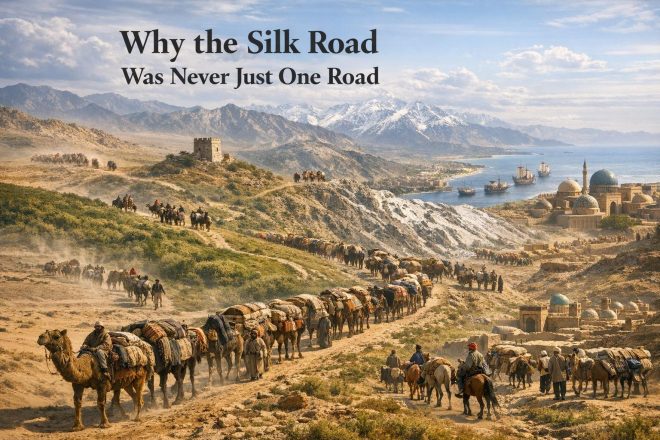
Multiple Routes, Not a Single Road
The term Silk Road has long evoked the image of a singular, linear artery stretching from East Asia to the Mediterranean. This image, while convenient, obscures the historical reality. What existed instead was a distributed system of overland and maritime corridors that evolved over centuries in response to geography, political authority, economic demand, and technological capacity. These routes connected imperial centers, regional markets, and local communities across Eurasia and, at times, beyond. Rather than a fixed road, the Silk Road functioned as a shifting lattice of pathways, anchored by nodal cities and mediated by intermediaries who rarely traversed its full extent.
The network’s structure was inherently modular. Caravans might travel between two adjacent regions—such as from the Tarim Basin to Transoxiana—before goods passed into new hands and continued onward through a separate circuit. This segmented movement made long-distance exchange possible without requiring any single actor to bridge the entire continent. At the same time, it ensured that the routes remained adaptable. Traders could reroute when confronted with natural barriers, political disruptions, or changing market conditions, reinforcing the decentralized nature of the system.
Geography and Environmental Constraints
The physical geography of Eurasia plays a central role in understanding why no single Silk Road could exist. The landmass is defined by formidable barriers that structure movement into corridors rather than open expanses. The Taklamakan Desert, one of the most inhospitable deserts in the world, forced travelers to skirt its northern and southern edges rather than cross it directly. These peripheral routes formed two major branches through the Tarim Basin, each dotted with oasis settlements sustained by glacial meltwater descending from surrounding mountain ranges.
To the west, the Pamir and Tien Shan mountain systems imposed further constraints. High-altitude passes were accessible only during limited periods of the year, and their traversal required specialized knowledge and equipment. These conditions favored the development of regional expertise, with local populations acting as guides, porters, and brokers. Meanwhile, the Iranian Plateau introduced its own challenges, including arid expanses and seasonal variations in temperature that influenced caravan scheduling.
Oasis cities emerged as critical nodes within this environment. Settlements such as Kashgar, Khotan, Samarkand, and Merv were not merely stopping points but logistical and commercial centers where goods were exchanged, repackaged, taxed, and redirected. These cities thrived because they occupied positions at the intersection of multiple routes. Their prosperity depended less on controlling a single pathway than on facilitating the convergence of many.
Environmental variability further reinforced this multiplicity. Harsh winters could close mountain passes, while drought conditions could reduce the viability of certain oasis corridors. In response, caravans adjusted their itineraries, sometimes shifting hundreds of kilometers to more favorable paths. The resulting system was dynamic and seasonal, reflecting a constant negotiation between human activity and ecological constraint.
Political Fragmentation and Control
The Silk Road traversed a mosaic of political entities, each exercising authority over segments of the network. From the Han and Tang dynasties in China to various Persian empires, nomadic confederations, and later Islamic caliphates, no single power maintained continuous control over the entire expanse. This fragmentation had significant implications for the organization of trade.
Each regime imposed its own regulatory framework. Taxes, tariffs, and transit duties were levied at key points, particularly at city gates, river crossings, and territorial boundaries. In some cases, states invested in infrastructure such as roads, caravanserais, and security patrols to encourage commerce. In others, instability or predatory governance discouraged movement, prompting traders to seek alternative routes. The viability of any given pathway depended on the balance between security and cost, both of which varied across regions and over time.
Periods of relative political consolidation tended to facilitate long-distance trade. The expansion of the Tang dynasty into Central Asia, or the establishment of stable regimes across parts of the Islamic world, created conditions in which merchants could operate with reduced risk. The most notable example is the era of Mongol dominance in the thirteenth and fourteenth centuries. The so-called Pax Mongolica did not create a single route, but it did align large segments of Eurasia under a relatively unified system of governance. This alignment enhanced communication, standardized certain practices, and provided a degree of protection for merchants.
Even under such conditions, however, the network retained its plural character. Political fragmentation reemerged as empires declined or shifted priorities, and traders once again diversified their routes. Diplomatic relations between states played a crucial role. Agreements could open corridors, while conflicts could close them abruptly. As a result, merchants operated with an awareness of geopolitical risk, often maintaining multiple pathways as a form of mitigation.
Commercial and Cultural Exchange
Although silk gave the Silk Road its name, it represented only one of many goods moving across Eurasia. Trade encompassed a wide range of commodities, including spices, horses, textiles, precious metals, glassware, and ceramics. The diversity of goods reflected the varied ecological zones and production capabilities of different regions. Central Asia, for example, was a major source of high-quality horses, while South Asia contributed spices and textiles, and the Mediterranean supplied finished goods and artisanal products.
Equally significant was the movement of ideas, technologies, and religious traditions. Buddhism spread from the Indian subcontinent into Central Asia and China through networks of monasteries and pilgrimage routes that often overlapped with commercial pathways. Islam later expanded into Central Asia, facilitated by trade and the establishment of Muslim merchant communities. Christianity, in its Nestorian form, also reached parts of East Asia through similar mechanisms.
Technological diffusion followed comparable patterns. Papermaking, which originated in China, spread westward and eventually transformed administrative and intellectual life in the Islamic world and Europe. Conversely, innovations from the West, including certain metallurgical techniques and artistic motifs, traveled eastward. These exchanges were not unidirectional; they represented a continuous process of interaction and adaptation across multiple nodes.
Cultural exchange occurred in layered and indirect ways. Artistic styles, linguistic elements, and social practices circulated alongside goods, often undergoing transformation as they moved between regions. The result was a series of hybrid cultures in key urban centers, where influences from different parts of Eurasia intersected. This process underscores that the Silk Road was less a conduit than an environment—a space in which interaction produced new forms of cultural expression.
Integration of Maritime Routes
While the overland routes have received significant attention, maritime pathways played an increasingly important role from the early centuries of the Common Era onward. The development of seafaring technologies and navigational knowledge allowed merchants to exploit seasonal wind patterns, particularly the monsoon system of the Indian Ocean. This facilitated regular, predictable voyages between ports in East Asia, Southeast Asia, South Asia, the Arabian Peninsula, and East Africa.
Ports such as Guangzhou, Calicut, and Basra became critical nodes in a maritime extension of the Silk Road network. Goods transported overland could be transferred to ships and carried across vast distances with greater efficiency, especially when dealing with bulk commodities. Maritime routes often complemented rather than replaced overland pathways, creating a hybrid system in which land and sea were interconnected.
The choice between land and sea routes depended on multiple factors. Maritime transport generally allowed for larger cargo volumes and lower costs per unit, but it also involved risks associated with weather, piracy, and limited navigational precision. Overland routes, while more expensive and slower, provided access to inland markets and allowed for more incremental trade across shorter segments. Traders frequently combined both modes, selecting routes based on prevailing conditions.
The integration of maritime and overland networks further reinforced the decentralized character of the Silk Road. Rather than converging into a single path, trade dispersed across multiple channels, each with its own advantages and constraints. This diversification enhanced resilience, ensuring that disruptions in one area did not necessarily halt the broader flow of goods and ideas.
The Modern “New Silk Road”
In contemporary discourse, the concept of the Silk Road has been revived through initiatives such as China’s Belt and Road Initiative (BRI). This framework seeks to enhance connectivity across Eurasia and beyond through investments in infrastructure, including railways, highways, ports, pipelines, and digital networks. While often presented as a unified project, the BRI more closely resembles the historical Silk Road in its multiplicity and fragmentation than in any notion of a singular corridor.
The modern network encompasses several distinct economic corridors, each shaped by regional priorities and geopolitical considerations. Routes linking China to Central Asia and Europe via rail differ significantly from those connecting Southeast Asia through maritime pathways or extending into South Asia through port development. These corridors are not uniformly integrated; they reflect bilateral and multilateral agreements, domestic political conditions, and varying levels of economic viability.
Geopolitics plays a central role in shaping the modern Silk Road. Infrastructure projects are often embedded within broader strategic calculations, including energy security, market access, and regional influence. Countries participating in these initiatives weigh potential economic benefits against concerns related to sovereignty, debt, and dependency. As in the past, the success of any given route depends on the alignment of political and economic interests among multiple actors.
Technological advancements have introduced new dimensions to the network. Digital infrastructure, including fiber-optic cables and satellite systems, forms a contemporary layer of connectivity that parallels physical transportation routes. Energy corridors, such as oil and gas pipelines, add another dimension, linking resource-rich regions with industrial and consumer markets. These developments expand the scope of what might be considered a Silk Road, extending it into domains that did not exist in antiquity.
Despite these innovations, the underlying logic remains consistent with historical patterns. The network is not fixed; it evolves in response to shifting economic conditions, political alignments, and technological capabilities. Competing initiatives from other regional actors, including the European Union, India, and various multilateral organizations, further contribute to a landscape characterized by overlapping and sometimes competing corridors.
Continuity and Misconception
The persistent image of a single Silk Road owes much to nineteenth-century European scholarship, which sought to impose coherence on a complex and fragmented reality. This simplification has endured in both academic and popular representations, shaping how the concept is understood and invoked. However, the historical evidence consistently points to a system defined by plurality rather than unity.
Recognizing this multiplicity is essential for interpreting both the past and the present. In historical terms, it highlights the role of local actors, regional dynamics, and environmental constraints in shaping long-distance exchange. In contemporary terms, it underscores the limits of viewing modern connectivity initiatives as singular, cohesive projects. The resilience of the Silk Road has always depended on its diversity, allowing it to adapt to disruptions and opportunities alike.
Understanding the Silk Road as a network rather than a road also shifts attention away from endpoints and toward connections. It emphasizes the interactions that occurred along the way—the exchanges of goods, ideas, and practices that shaped societies across Eurasia. This perspective aligns more closely with the historical reality and provides a more useful framework for analyzing current developments.
In both its historical and modern manifestations, the Silk Road represents an evolving system of connectivity. Its structure reflects the interplay of geography, politics, economics, and culture across vast distances. By moving beyond the notion of a single route, one can better appreciate the complexity and adaptability that have defined this network over time.