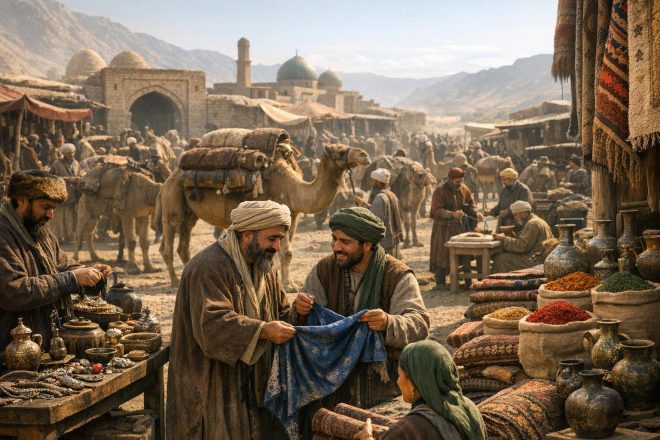
Daily Life of Traders on the Silk Road
The daily life of traders along the Silk Road was structured by long-distance movement, negotiation across cultures, and constant adaptation to environmental and political conditions. Activity was rarely continuous travel; instead, it alternated between periods of movement and extended stays in caravanserais, oasis towns, and major urban centers such as Samarkand, Bukhara, and Kashgar. These rhythms created a pattern of life that was neither wholly itinerant nor settled, but rather a hybrid existence shaped by geography, commerce, and diplomacy.
To understand this world, it is necessary to move beyond the simplified image of a single “road” and instead consider a network of interconnected routes extending from East Asia across Central Asia into the Middle East and the Mediterranean. Each segment of this network imposed its own demands on traders. Deserts required endurance and logistical foresight; mountain passes demanded timing and specialized animals; urban centers required linguistic skill and familiarity with local customs. Traders were therefore not only merchants but also negotiators, cultural intermediaries, and logistical planners.
Daily life was influenced by both routine and uncertainty. While there were habitual practices governing travel, packing, and trade, there was also constant exposure to unpredictable conditions. Weather, political shifts, and fluctuating markets all shaped the trader’s experience. The Silk Road was not simply an economic system; it was a lived environment in which individuals navigated complexity on a daily basis.
Travel Routines and Logistics
Movement along the Silk Road followed carefully structured routines. Caravans typically began their day before sunrise, particularly in arid regions where daytime temperatures could become prohibitive. Early departure maximized travel efficiency and minimized stress on both humans and animals. The caravan would proceed in a slow but steady pace, often covering between 20 and 40 kilometers per day depending on terrain and conditions.
The composition of a caravan reflected both economic capacity and environmental requirements. Large caravans could include dozens or even hundreds of animals, primarily camels in desert regions due to their endurance and ability to carry heavy loads with minimal water. In mountainous zones, traders relied more heavily on horses, mules, or yaks, each suited to specific altitudes and terrain. The selection of animals was not arbitrary; it required knowledge of regional conditions and careful planning to ensure that the caravan could progress without excessive loss.
Leadership within the caravan was typically hierarchical. A caravan master, often an experienced merchant, coordinated movement, negotiated passage, and made decisions regarding routes and stops. Supporting roles included animal handlers, guards, guides familiar with local terrain, and occasionally scribes responsible for documenting transactions. This internal organization allowed caravans to function as mobile institutions capable of sustaining themselves over long distances.
Goods were packed according to standardized systems designed to balance loads and minimize damage. Silk, spices, precious metals, glassware, and manuscripts each required different methods of storage and protection. Silk, although lightweight, needed protection from moisture; spices required careful sealing to preserve quality; fragile goods such as glassware were packed with padding materials and often carried in specially designed containers. The process of loading a caravan could take several hours and was treated as a critical task, as improper packing increased the risk of loss during transit.
Breaks were built into the daily schedule. Around midday, caravans would halt to rest, water animals, and allow for food preparation. This pause was essential not only for physical recovery but also for maintaining morale among caravan members. Travel would sometimes resume in the late afternoon if conditions permitted, but more often the caravan sought a suitable stopping point before sunset.
Evening encampments were chosen with care. Access to water was essential, as was protection from both environmental hazards and potential нападения. In more developed regions, caravans aimed to reach caravanserais—purpose-built structures offering lodging, storage, and security. In more remote areas, temporary camps were established, often with guards posted throughout the night.
Commercial Practices
Trade along the Silk Road was rarely conducted as a single continuous journey by one merchant carrying goods from origin to destination. Instead, commerce functioned through segmented exchanges. Goods changed hands multiple times as they moved across regions, with each trader specializing in particular segments of the route. This system reduced risk and allowed merchants to operate within areas where they had established relationships and knowledge.
A trader departing from Central Asia, for example, might sell goods in a Persian city and use the proceeds to purchase new commodities suited for markets further west. This practice of rotational trade minimized exposure to unfamiliar conditions and reflected the decentralized nature of Silk Road commerce. It also contributed to price variation, as goods accumulated value at each stage of exchange.
Negotiation was central to every transaction. Prices were influenced by scarcity, seasonality, and political stability. In times of conflict, certain goods became difficult to obtain, increasing their value. Conversely, periods of stability and abundant supply could reduce prices. Merchants needed to stay informed about market conditions in multiple regions, often relying on networks of informants and fellow traders.
Linguistic ability was a critical asset. Many traders were multilingual, capable of communicating in several languages or dialects. Sogdian, Persian, Turkic dialects, and later Arabic functioned as commercial lingua francas across different segments of the Silk Road. In cases where direct communication was not possible, interpreters facilitated negotiations. Miscommunication could result in financial loss, making linguistic competence a key component of commercial success.
Accounting practices varied, but many traders maintained detailed records of transactions. Written accounts were often kept using scripts and systems influenced by Persian or Indian traditions. In some cases, oral accounting techniques were used, particularly among traders operating within trusted networks. Credit and partnership arrangements were common, allowing merchants to finance large ventures and distribute risk among multiple participants.
Trust was fundamental to these practices. Given the distances involved and the absence of centralized enforcement mechanisms, traders relied heavily on reputation and established relationships. Breaches of trust could have long-lasting consequences, effectively excluding individuals from future trade opportunities.
Social and Cultural Interactions
Caravanserais functioned as essential nodes within the Silk Road network. These structures provided more than basic lodging; they served as centers of communication, exchange, and cultural interaction. Within their walls, merchants from diverse regions gathered, bringing with them not only goods but also information. News about road conditions, political developments, and market trends circulated rapidly in these spaces.
The social environment of a caravanserai was dynamic. Traders, pilgrims, scholars, and officials shared space, creating opportunities for interaction across cultural and religious boundaries. It was not uncommon to encounter Buddhist monks, Muslim scholars, and Nestorian Christians within the same compound. Religious practices were often conducted side by side, reflecting a pragmatic tolerance shaped by the necessities of trade.
Food and daily routines within caravanserais reflected this diversity. Meals varied depending on regional availability, but shared dining spaces facilitated informal exchanges of information. These interactions contributed to the diffusion of ideas, technologies, and artistic influences across regions.
Marriage alliances and long-term partnerships further integrated traders into local societies. Merchants often spent extended periods in key торговых centers, during which they established familial and commercial ties. These relationships strengthened trust networks and provided a stable foundation for ongoing trade.
Diaspora communities played a particularly significant role. Sogdian merchants, for example, established settlements across Central Asia and beyond, creating networks that facilitated communication and supported trade activities. These communities maintained connections with their places of origin while adapting to local conditions, effectively bridging different regions of the Silk Road.
Risks and Political Context
The Silk Road was characterized by both opportunity and risk. Traders faced a range of hazards, including banditry, extreme weather, and fluctuating political conditions. Desert crossings posed challenges related to heat, water scarcity, and navigation, while mountain routes exposed caravans to cold temperatures and difficult terrain.
Banditry was a persistent threat, particularly in regions where state control was weak. To mitigate this risk, traders traveled in caravans and often hired guards. In some cases, local authorities provided military escorts, particularly along strategic routes. The level of security varied significantly depending on the political context.
The role of states was crucial in shaping the conditions of trade. Periods of strong centralized control, such as during the Pax Mongolica in the 13th and 14th centuries, facilitated movement by reducing transaction costs and improving security. Under Mongol rule, standardized systems of taxation and protection allowed traders to move more freely across vast ტერიტორიები.
In contrast, periods of fragmentation and conflict increased uncertainty. Multiple authorities imposed tariffs and tolls, complicating routes and raising costs. Traders often needed to secure permissions from various officials, a process that could involve negotiation and delays. Tribute systems and diplomatic relations between states also influenced access to certain المناطق.
Time itself was shaped by these political realities. Traders frequently spent extended periods waiting for favorable conditions, whether due to seasonal constraints or the need for safe passage. Such অপেক্ষা was not merely passive; it often involved active engagement in local markets and communities.
Knowledge, Information, and Adaptation
Information was one of the most valuable commodities along the Silk Road. Traders depended on accurate knowledge of routes, weather patterns, political conditions, and market الأسعار. This information was gathered through personal experience, communication with other merchants, and participation in established networks.
Maps, where they existed, were often schematic and supplemented by oral knowledge. Experienced guides played a critical role in navigation, particularly in المناطق where الطريق markings were minimal. Memory and روایت were essential tools, passed down through generations of traders.
Adaptation was a constant requirement. Environmental conditions could change rapidly, requiring adjustments in route or timing. Political shifts could open or close pathways, necessitating flexibility in التجاري strategies. Successful traders were those who could respond effectively to these تغيرات while maintaining their networks and reputations.
Urban Centers and Periods of Settlement
Although movement defined much of their existence, traders also experienced periods of relative स्थिरता in major urban centers. Cities such as Samarkand and Bukhara functioned as التجاري hubs where goods were exchanged, stored, and redistributed. These المدن offered infrastructure that supported extended stays, including warehouses, financial services, and administrative institutions.
During these periods, daily life took on a different rhythm. Traders engaged in market activities, negotiated contracts, and maintained their networks. They also participated in the cultural and social life of the city, attending religious institutions, engaging in scholarly discussions, and forming personal relationships.
Urban centers were also مواقع of الإنتاج and transformation. Raw materials were processed into finished goods, adding value before further distribution. This integration of التجارة and წარმო contributed to the economic vitality of Silk Road cities.
Continuities and the Modern Context
While the historical Silk Road declined with the expansion of maritime trade routes, its underlying patterns of exchange continue to influence contemporary developments. Modern initiatives such as China’s Belt and Road Initiative reflect a पुनर्परिभाषा of these historical connections, emphasizing infrastructure development, regional integration, and economic cooperation.
Despite significant differences in technology and scale, certain core factors remain consistent. Corridor security, political stability, and efficient logistics continue to shape trade flows. आधुनिक النقل systems have reduced यात्रा time dramatically, but the महत्व of coordination across jurisdictions persists.
The comparison between historical and modern systems highlights both continuity and परिवर्तन. Where caravans once moved goods over months or years, trains and ships now accomplish similar journeys in days or weeks. However, the fundamental challenges of managing complex networks across diverse political and cultural environments remain largely unchanged.
The daily life of Silk Road traders, therefore, offers insight into broader patterns of human interaction, economic organization, and cultural exchange. It illustrates how individuals navigated a complex world through a combination of routine, adaptability, and cooperation. These patterns, while rooted in इतिहास, continue to resonate in contemporary discussions of globalization and regional connectivity.