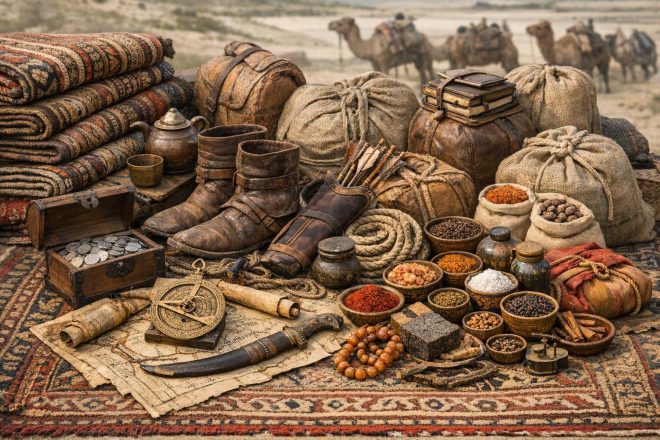
Commercial Priorities and Environmental Constraints
Merchants traveling along the Silk Road confronted a logistical environment that imposed discipline on every decision they made. A journey across Eurasia was not a linear trip between two fixed markets, but a prolonged engagement with shifting ecological zones, political authorities, and commercial opportunities. As a result, packing for such expeditions became a structured exercise in risk management, capital allocation, and environmental adaptation. Goods had to be carefully chosen not only for their exchange value but also for their resilience under extreme conditions and their compatibility with long-distance transport technologies.
At the center of these considerations was a simple constraint: transport capacity was limited and costly. Pack animals such as Bactrian camels, yaks, and horses could only carry so much weight while maintaining sufficient endurance for multi-stage travel. Consequently, merchants selected goods that maximized value relative to bulk and fragility. Items such as silk, spices, precious stones, and fine textiles met these criteria effectively. Silk, in particular, offered an exceptional combination of light weight, high price, and durable storage. Its resistance to decay and its universal desirability across different civilizations made it a near-ideal commodity for long-distance exchange.
Environmental constraints imposed additional layers of decision-making. The Silk Road traversed some of the most challenging landscapes on the Eurasian landmass, including the Taklamakan Desert, the Iranian Plateau, and the high-altitude passes of the Pamir and Tian Shan ranges. In arid regions, the availability of water dictated not only the route but also the rhythm of movement. Merchants needed to allocate space for water storage, preserved foods, and durable clothing, often prioritizing these necessities over potentially profitable but non-essential goods.
Food supplies were chosen for caloric density and longevity. Dried dates, hard grains, and salted meats were staples because they could withstand temperature fluctuations without spoilage. The design of clothing similarly reflected environmental realities. Desert travel required garments that protected against intense solar exposure during the day while retaining warmth at night, whereas mountain crossings demanded heavy wool and fur insulation. These differing requirements meant that caravans often carried layered clothing systems adaptable to varying climates encountered along a single journey.
The selection of pack animals further illustrates the intersection of environmental constraints and commercial strategy. Bactrian camels, with their dual humps and tolerance for both cold and heat, were particularly suited to Central Asian conditions. Their ability to endure long stretches without water made them indispensable for desert crossings. However, in mountainous terrain, where agility and sure footing were more important than load capacity, yaks and smaller horses were often preferred. Merchants thus tailored not only their cargo but also their transport systems to the landscapes they would encounter.
The need for adaptability extended to route planning. Seasonal variations could transform a viable path into a hazardous one. Snow blocked mountain passes during winter, while summer heat intensified desert hazards. Merchants often timed their departures to align with favorable conditions, and their packing choices reflected these temporal considerations. A caravan departing in spring might prioritize different goods and provisions than one leaving in autumn, even if their intended destination remained the same.
Environmental pressures also influenced the social organization of trade. Individual merchants rarely traveled alone across long stretches. Instead, caravans formed as cooperative entities that pooled resources and shared risks. In such settings, the distribution of goods across animals and among participants had to be coordinated. This collective dimension further shaped packing practices, as redundancy in essential supplies could mean the difference between survival and failure.
Trade Goods and Regional Specialization
The Silk Road functioned not as a singular highway but as a network of interconnected corridors linking diverse economic zones. Each region along this network developed distinctive forms of production shaped by local resources, labor structures, and technological traditions. As a result, trade along the Silk Road was characterized by a high degree of regional specialization, with merchants acting as intermediaries who facilitated the movement of goods between complementary economies.
Chinese merchants, operating from one of the most technologically sophisticated centers of the premodern world, supplied silk, lacquerware, and paper. These goods reflected advanced manufacturing processes and artisanal skills that were difficult to replicate elsewhere. Silk production, in particular, was closely guarded within China for centuries, giving it a near-monopolistic position in early trade. Lacquerware, valued for its durability and aesthetic qualities, demonstrated chemical knowledge of resins and coatings that enhanced both functionality and visual appeal. Paper, as a medium of communication, would eventually transform administrative and intellectual life across Eurasia.
From the Indian subcontinent came spices, ivory, and textiles, products that were tied to both ecological diversity and long-standing craft traditions. Spices such as pepper and cardamom were highly valued not only for their culinary uses but also for their preservative and medicinal properties. Ivory, sourced from elephant populations, supported luxury carving industries. Indian textiles, often dyed using complex techniques, competed effectively in multiple markets.
The Mediterranean world contributed glassware, silver, and wine, goods that reflected both resource availability and artisanal development. Roman and later Byzantine glass production achieved high levels of clarity and form, making it a sought-after commodity. Silver coinage also played a role not just as currency but as a tradable material. Wine, while bulky and less ideal for long-distance transport, still circulated in certain segments of the network, particularly where demand justified the logistical costs.
Central Asia occupied a pivotal position as an intermediary zone. Merchants and pastoral groups in this region facilitated exchanges between East and West while also contributing their own specialized products. Among the most notable were horses, which were highly valued in imperial China for military purposes. The acquisition of strong, fast horses from Central Asia became a strategic priority for Chinese states, influencing diplomatic and trade relations.
One of the defining characteristics of Silk Road trade was its incremental nature. Goods rarely traveled from their point of origin to their final destination in a single transaction. Instead, they were exchanged multiple times along the route, accumulating value at each stage. A bolt of silk might pass through several hands, being traded for different goods and currencies before reaching a distant market. This process allowed merchants to respond flexibly to changing conditions, including fluctuations in demand, political instability, and local shortages.
Incremental trade also meant that merchants often carried a diverse portfolio of goods rather than specializing exclusively in one category. By doing so, they could engage in opportunistic exchanges at various points along the route. This strategy reduced risk by diversifying potential revenue sources and allowed traders to adapt to local market conditions. Packing decisions therefore reflected not only initial trade intentions but also anticipated opportunities for intermediate transactions.
The cultural dimensions of regional specialization further enriched these exchanges. Goods carried symbolic meanings that extended beyond their material value. Textiles, for example, could signify social status, while spices might be associated with particular culinary or medicinal traditions. As these items moved across regions, they contributed to the diffusion of cultural practices and preferences, reinforcing the integrative role of the Silk Road.
Financial Instruments and Security
The movement of valuable goods across vast distances exposed merchants to significant risks, including theft, loss, and political disruption. Carrying large quantities of coinage was particularly dangerous, as it made caravans attractive targets for banditry. In response, traders developed and adopted financial instruments that allowed them to transfer wealth without physically transporting it in vulnerable forms.
Among the most important of these innovations were letters of credit and trusted intermediaries. These instruments enabled a merchant to deposit funds in one location and withdraw corresponding value in another, often through a network of affiliated agents. Such systems required a high degree of trust and institutional support, as well as mechanisms for verifying authenticity and enforcing agreements. In many cases, merchant communities themselves provided the necessary infrastructure, relying on shared norms and reputational systems to ensure compliance.
Islamic trading centers played a particularly significant role in the development of these financial practices. Legal frameworks grounded in Islamic jurisprudence supported commercial contracts, partnerships, and credit arrangements that facilitated long-distance trade. Instruments such as the sakk (a precursor to the modern cheque) allowed merchants to conduct transactions across regions without exposing themselves to undue risk. These innovations contributed to the integration of markets across the Silk Road and beyond.
Despite these financial advances, physical security remained a constant concern. Caravans often organized themselves into large groups to deter potential attacks. The presence of armed guards was common, and provisions had to be made for their compensation and sustenance. Traders allocated part of their resources to weapons, guards’ wages, and gifts, recognizing that security expenditures were an integral component of commercial operations rather than an optional expense.
Diplomatic strategies also formed an essential aspect of security. Many segments of the Silk Road passed through territories controlled by local rulers, tribal leaders, or nomadic groups. Securing safe passage often required negotiation and the exchange of gifts. These offerings, which could include luxury goods or other valuable items, functioned as both tribute and investment in continued access. Merchants who neglected such practices risked encountering obstruction or hostility.
The institutional dimension of security was equally important. In some regions, states actively supported trade by maintaining infrastructure, policing routes, and offering protection to merchants. The stability provided by large empires, such as the Tang dynasty in China or later the Mongol Empire, facilitated periods of intensified trade activity. Under Mongol rule, for instance, the establishment of relay stations and the enforcement of law across vast ტერიტორი made long-distance travel comparatively safer than in more fragmented periods.
Nevertheless, security conditions could change rapidly. Political upheavals, wars, and shifts in territorial control had direct implications for trade routes. Merchants had to remain informed about these developments and adjust their plans accordingly. Packing strategies, financial arrangements, and route selection were all influenced by assessments of current risks. This constant need for situational awareness underscored the dynamic nature of Silk Road commerce.
Daily Necessities and Cultural Exchange
While high-value goods attracted the most attention, the everyday contents of a caravan were equally vital to its functioning. Sustaining a group of travelers and animals over extended periods required careful planning and provisioning. Dried foods, including dates, grains, and salted meat, formed the dietary foundation for most journeys. These items were chosen for their durability and ease of transport, as well as their ability to provide sufficient nutrition under demanding conditions.
Cooking equipment was simple but essential. Portable stoves, pots, and utensils allowed merchants to prepare meals using limited resources. Fuel availability varied across regions, so caravans sometimes carried their own supply or relied on materials encountered along the way. Tents provided shelter from environmental exposure, and their design reflected the need for quick assembly and disassembly.
Medical supplies occupied a critical place in caravan inventories. The remoteness of many segments of the Silk Road meant that access to formal medical care was limited or nonexistent. Traders relied on a combination of practical knowledge and traditional remedies to address injuries and illnesses. Herbal medicines, bandages, and basic surgical tools were commonly included among provisions. The survival of both individuals and animals depended on the effective management of health risks.
Documentation represented another essential category of items. Contracts, correspondence, and records of transactions needed to be preserved throughout the journey. Merchants often stored such documents in protective cases to shield them from environmental damage. Written materials also facilitated communication across linguistic and cultural boundaries, enabling trade between groups with limited direct interaction.
The Silk Road served not only as a conduit for goods but also as a channel for the transmission of ideas and cultural practices. Items carried by merchants frequently included books, religious texts, and artistic objects that reflected diverse intellectual traditions. The movement of these materials contributed to the spread of major religious systems, including Buddhism, Islam, and Christianity. Monks, scholars, and missionaries often traveled alongside traders or followed established routes, using the same logistical networks to reach new audiences.
Cultural exchange was not limited to formal doctrines. Artistic motifs, technological innovations, and linguistic elements also circulated across the Silk Road. The adoption of new artistic styles or manufacturing techniques often accompanied the introduction of foreign goods. For example, textile patterns and decorative forms could be adapted and reinterpreted in different regions, creating hybrid expressions that reflected multiple influences.
Food culture provides another example of this exchange. Ingredients and culinary methods moved alongside trade goods, leading to the incorporation of new flavors and techniques into local cuisines. Spices transported from South Asia to the Mediterranean, for instance, reshaped culinary practices in ways that persisted long after the decline of traditional Silk Road routes.
The everyday contents of a caravan thus embodied both practical necessity and cultural interaction. Each item served a functional purpose while also participating in a broader process of exchange that linked distant societies. The cumulative effect of these movements was the gradual integration of Eurasian cultural and economic systems.
Continuities in the Modern “New Silk Road”
Contemporary discussions of the “New Silk Road,” particularly in the context of China’s Belt and Road Initiative (BRI), often emphasize the scale and technological sophistication of modern infrastructure. High-speed railways, container shipping, and digital logistics platforms have transformed the mechanics of long-distance trade. However, the underlying principles that shaped historical Silk Road commerce remain visible in contemporary practices.
Modern logistics networks continue to prioritize high-value, time-sensitive goods, echoing the emphasis on value-to-weight ratios that guided historical merchants. Electronics, pharmaceuticals, and precision machinery occupy roles analogous to those once held by silk and spices. While transportation capacity has increased dramatically, cost efficiency and risk management still favor goods that maximize economic return relative to logistical investment.
Environmental considerations have not disappeared, although they manifest differently. Infrastructure projects must account for terrain, climate, and ecological impact, just as caravans once did. Railway routes, pipelines, and highways are designed with attention to geographic constraints, including mountains, deserts, and seismic zones. Climate conditions continue to influence operational decisions, affecting everything from shipping schedules to maintenance requirements.
Financial instruments have evolved into highly sophisticated systems involving digital transactions, international banking networks, and real-time data processing. Yet the fundamental objective remains the same: reducing risk while facilitating the movement of capital across distances. The transition from physical letters of credit to electronic systems represents a technological shift rather than a conceptual one.
Security concerns also persist, though their nature has changed. Instead of banditry, modern trade faces risks such as geopolitical tensions, regulatory barriers, and cyber threats. States play a central role in managing these risks, negotiating agreements, and establishing frameworks that enable or constrain trade flows. The geopolitical dimensions of the BRI illustrate how infrastructure development is closely intertwined with strategic considerations.
The incremental nature of trade, characteristic of the historical Silk Road, can still be observed in global supply chains. Goods often pass through multiple stages of production and distribution before reaching final consumers. Components manufactured in different countries are assembled into finished products, reflecting a complex web of interdependence that parallels earlier patterns of exchange.
Cultural exchange remains an integral aspect of modern connectivity. The movement of people, ideas, and cultural products continues alongside economic activity. Educational exchanges, tourism, and media dissemination contribute to ongoing interactions between societies linked by contemporary trade networks.
Despite these continuities, it is important to recognize the differences that distinguish the modern context from its historical antecedents. The scale of trade has expanded exponentially, supported by technological innovations that reduce time and cost. Political structures, including nation-states and international organizations, provide a framework that differs significantly from the fragmented and often localized authorities of the past. Nevertheless, the enduring influence of geography, economic incentives, and risk management underscores the relevance of Silk Road precedents.
The comparison between historical and modern systems highlights the persistence of fundamental economic behaviors across time. Merchants, whether operating with camel caravans or container ships, must balance profitability, security, and environmental constraints. These enduring considerations provide a throughline that connects the ancient Silk Road to its contemporary reinterpretations.
In this sense, the Silk Road is not merely a historical phenomenon but a lens through which to understand broader patterns of human interaction. The practical decisions made by merchants—what to carry, how to travel, and how to manage risk—reflect underlying dynamics that continue to shape global trade. The evolution of these practices illustrates both continuity and change, offering insight into the complex interplay of commerce, environment, and geopolitics across Eurasia.