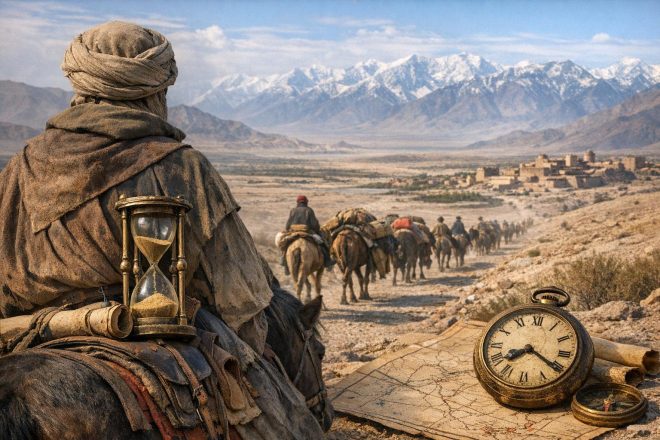
The question of how long a journey along the Silk Road “really” took has no single answer, as the so-called Silk Road was not a single road but a network of routes spanning East Asia, Central Asia, the Middle East, and the Mediterranean. Travel time depended on distance, season, political conditions, and the type of traveler. The phrase itself, “Silk Road,” is a nineteenth-century scholarly construct, and although it effectively captures the importance of transcontinental exchange, it can obscure the fragmented and highly localized realities of movement across Eurasia. Merchants, envoys, pilgrims, and soldiers experienced the network differently, and their timelines varied accordingly. Nonetheless, historical evidence from travel accounts, administrative records, and archaeological findings allows us to outline realistic timeframes and to understand how time functioned within this vast system of exchange.
Typical Travel Durations
A full journey from eastern China, such as Chang’an (modern Xi’an), to the eastern Mediterranean could take one to three years under relatively stable conditions. This estimate assumes movement by caravan, which typically progressed at an average of 20 to 30 kilometers per day, depending on terrain and climate. Even this pace was not continuous. Caravans frequently stopped for extended periods, sometimes lasting weeks or months, in order to conduct trade, wait out adverse weather, or navigate administrative requirements imposed by local authorities.
The notion of a single individual traversing the entire route was, in practice, uncommon. Merchants rarely undertook the full transcontinental journey themselves. Instead, trade was segmented. Goods were exchanged multiple times along the route, moving incrementally from one region to another. A merchant operating in the Tarim Basin might never travel beyond Central Asia, while a Middle Eastern trader might specialize in routes west of the Iranian plateau. As a result, while the total transit time for goods might span several years, individual actors typically experienced only a portion of that timeline.
Travelers with specific missions, such as diplomatic envoys or religious pilgrims, sometimes aimed to complete longer distances as efficiently as possible. Even so, their journeys were constrained by the same physical and political realities. The famous Chinese monk Xuanzang, who traveled to India in the seventh century, spent over a decade on his journey, though this duration included extended अध्ययन and not merely transit. His account illustrates both the possibilities and the unpredictability of long-distance movement.
Geographical Constraints and Environmental Rhythms
Geography exerted a fundamental influence on travel time. The Silk Road traversed some of the most challenging environments in the world, including arid deserts, high mountain ranges, and steppe regions subject to extreme temperature variation. These environments did not merely slow travel; they dictated its rhythms.
The Taklamakan Desert, often described in later sources as a place one entered but did not leave, was skirted rather than crossed directly. Caravans moved along its northern and southern edges, linking a chain of oasis towns such as Kucha, Khotan, and Turfan. These oases functioned as essential توقف points, providing water, food, and opportunities for trade. However, movement between them required careful planning. A miscalculation in supplies could prove fatal, and caravans often waited until conditions were optimal before attempting desert crossings.
The Pamir and Tien Shan mountain systems posed different challenges. High altitudes, steep passes, and unpredictable weather limited travel to specific seasons. Snow could block routes for months, forcing caravans to either delay their journeys or take longer alternative paths. In some cases, travelers needed to disassemble their loads and rely on specialized pack animals, such as yaks, to navigate particularly difficult terrain.
Seasonality was therefore central to Silk Road travel. Summer heat in desert regions could be as prohibitive as winter cold in mountainous areas. Caravans often operated within narrow seasonal windows, leading to periods of intense activity followed by relative inactivity. These environmental rhythms contributed significantly to the overall duration of journeys, as delays were often unavoidable.
Political Frameworks and Security
Political stability played a decisive role in determining travel time and reliability. The Silk Road passed through numerous political entities, ranging from large empires to small oasis kingdoms and tribal territories. Each jurisdiction imposed its own regulations, taxes, and security conditions.
Periods of strong imperial control tended to facilitate faster and safer movement. Under the Tang Dynasty in China or the Abbasid Caliphate in the Middle East, state authorities invested in infrastructure such as roads, caravanserais, and administrative systems that supported long-distance trade. The Mongol Empire, in particular, is often highlighted for its role in enhancing connectivity across Eurasia during the thirteenth and fourteenth centuries. The so-called Pax Mongolica provided a degree of political unity that reduced the risks associated with cross-continental travel. Relay systems, protected routes, and standardized practices allowed envoys and merchants to move with greater efficiency than in more fragmented periods.
In contrast, times of political fragmentation or conflict introduced significant delays. Caravans might be forced to reroute to avoid hostile territories, negotiate passage with multiple authorities, or hire additional protection against banditry. Warfare could disrupt key المدن and trade hubs, causing bottlenecks or necessitating entirely new маршруты. These disruptions not only increased travel time but also introduced uncertainty, making long-distance trade a more precarious undertaking.
Economic Practices and Commercial Logic
Economic practices along the Silk Road were structured around gradual exchange rather than continuous transport. Caravans were not merely vehicles for movement; they were also mobile trading entities. At each major توقف point, merchants engaged in buying and selling goods, adjusting their cargo based on local demand and price fluctuations.
This commercial logic extended the duration of journeys. A caravan might arrive in an oasis city and remain there for several weeks, negotiating transactions, securing new partners, and preparing for the next leg of the route. These pauses were not incidental but integral to the functioning of the Silk Road economy. They allowed for the redistribution of goods and the integration of regional markets into a broader network.
Financial instruments and credit arrangements also played a role. In some regions, merchants relied on partnerships or contracts that allowed goods to be transferred without the physical movement of the original trader. Such practices reduced the need for individuals to undertake long journeys while still enabling the flow of commodities across vast distances.
The types of goods being transported further influenced timing. High-value, low-bulk items such as silk, spices, and precious stones were particularly suited to long-distance trade because they justified the costs and risks of extended transport. Bulk goods, by contrast, were typically traded over shorter distances or within regional networks.
Segmented Trade and the Relay System
It is important to emphasize that the Silk Road functioned less as a continuous expedition and more as a relay system. Goods rarely traveled directly from their point of origin to their final destination under the supervision of a single merchant. Instead, they moved through a سلسلة of intermediaries, each responsible for a segment of the journey.
This segmentation had several implications for travel time. On one hand, it allowed for a more efficient allocation of expertise and resources, as local traders were better equipped to navigate specific regions. On the other hand, it introduced delays associated with transfers, negotiations, and coordination between different actors.
For example, silk produced in China might be transported to Central Asia by one group of merchants, then sold to another group who carried it westward to the Iranian plateau, and finally passed on to traders operating in the Mediterranean sphere. Each transfer involved both logistical and commercial processes, contributing to the overall duration of the journey.
Communication operated in a similar manner. Information, like goods, moved step by step, often taking months or years to traverse the full extent of the network. This incremental flow shaped the diffusion of ideas, technologies, and cultural practices across Eurasia.
Travelers and Their Experiences
The experience of Silk Road travel varied significantly depending on the traveler’s purpose and status. Merchants, as noted, often moved in caravans for safety and efficiency. These caravans could range in size from a few dozen to several hundred individuals, accompanied by pack animals such as camels, horses, and donkeys. Large caravans offered greater protection against potential threats but required more complex coordination.
Diplomatic envoys and official messengers sometimes enjoyed advantages not available to ordinary traders. They might be provided with escorts, access to relay stations, and official documents granting them safe passage. Such support could reduce travel time considerably, though it did not eliminate the challenges posed by geography and climate.
Religious pilgrims represent another important category of travelers. Their journeys were often motivated by spiritual goals rather than economic considerations, and they might spend extended periods in particular locations for study or worship. The routes taken by Buddhist monks traveling between China and India, for instance, became conduits for the transmission of religious texts and artistic influences.
Despite these differences, all travelers faced a degree of uncertainty. Illness, accidents, and unforeseen الأحداث could disrupt even the most carefully planned journeys. As a result, estimates of travel time must always be understood as approximate rather than definitive.
Infrastructure and Logistical Support
The functioning of the Silk Road depended on a range of infrastructural elements that both enabled and constrained movement. Caravanserais, or roadside inns, were among the most significant. Located at intervals along major routes, they provided shelter, food, and water for travelers and their animals. Some were simple enclosures, while others were substantial complexes equipped to accommodate large caravans.
Roads themselves varied in quality. In some regions, particularly within powerful empires, routes were maintained and marked to facilitate travel. In others, paths were informal and subject to change due to environmental conditions or human activity. The absence of standardized infrastructure across the entire network contributed to variability in travel times.
Administrative systems also played a role. Travelers often required permits or paid tolls at various checkpoints. These processes could introduce delays but also provided a degree of regulation and security. In well-organized states, such systems helped to integrate long-distance trade into broader economic and political structures.
Comparative Perspectives on Time and Distance
Understanding Silk Road travel times requires a shift in perspective regarding distance and duration. In a premodern context, journeys were measured not only in kilometers but in stages, seasons, and توقف points. Time was experienced as a series of segments rather than a continuous flow.
This segmented perception contrasts with modern expectations of speed and directness. Today, advancements in transportation and communication have compressed both time and space, enabling rapid movement across distances that once required months or years. The comparison highlights the extent to which the Silk Road was shaped by the limitations and possibilities of its historical context.
Continuities and Modern Comparisons
In the contemporary era, the concept of a “New Silk Road” has emerged to describe a range of infrastructure projects and trade initiatives aimed at enhancing connectivity across Eurasia. China’s Belt and Road Initiative (BRI) is the most prominent example, encompassing investments in railways, ports, and other forms of transport infrastructure.
These modern corridors have dramatically reduced transit times. Rail freight between China and Europe can now be completed in approximately two to three weeks, a fraction of the time required in premodern periods. Air transport further compresses these timelines, enabling goods and people to move between continents within days or even hours.
Despite these differences, certain continuities remain. Geography continues to shape routes, even if its constraints have been mitigated by technology. Political factors, including international relations and regulatory frameworks, still influence the flow of goods and people. Economic practices, though transformed, retain elements of the intermediary systems that characterized earlier periods.
The comparison between the historical Silk Road and its modern counterparts underscores both change and continuity. While technological advancements have altered the scale and speed of connectivity, the underlying dynamics of trade, negotiation, and adaptation to diverse environments remain relevant.
Conclusion: Time as a Structural Feature of the Silk Road
The duration of travel along the Silk Road cannot be reduced to a single figure. Instead, it must be understood as a variable shaped by geography, politics, economics, and human agency. A journey from East Asia to the Mediterranean might take one to three years under favorable conditions, but this estimate encompasses a wide range of experiences and outcomes.
More importantly, the Silk Road was not defined by continuous long-distance travel but by a system of segmented exchange. Goods, ideas, and people moved through a network of interconnected routes, with each segment contributing to the overall process. Time, in this context, was not merely a measure of duration but a structural feature of the system itself.
Examining travel times within the Silk Road framework provides insight into the broader functioning of premodern Eurasian connectivity. It reveals a world in which movement was both constrained and enabled by a complex interplay of factors, and in which the journey itself was as significant as the destination.