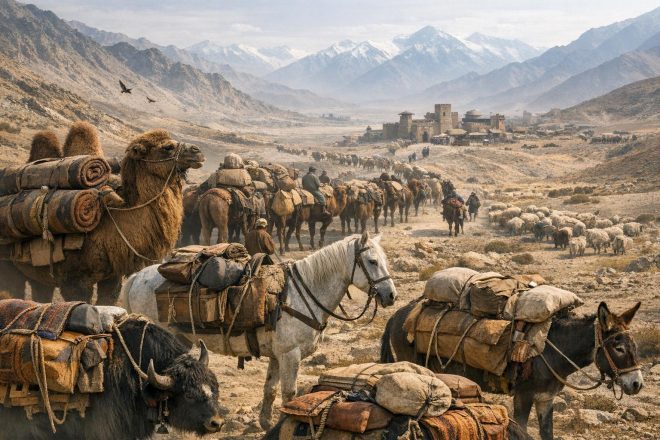
Animal Labor and the Functioning of Silk Road Trade
The movement of goods across Eurasia depended on animals that could endure extreme climates, long distances, and limited resources. Trade routes collectively known as the Silk Road were not continuous paved roads but networks of paths crossing deserts, mountains, and steppe. These routes emerged over centuries through patterns of repeated movement rather than formal planning, and their viability rested on a dynamic relationship between geography, ecology, and human organization. Without animal transport, sustained exchange between East Asia, Central Asia, the Middle East, and the Mediterranean would not have been viable.
The Silk Road should therefore be understood not simply as a commercial system but as a logistical ecosystem in which animal physiology imposed real constraints on economic activity. Distance, gradient, temperature, and access to fodder were not abstract variables but material limits that shaped decision-making at every level. Merchants, caravan leaders, and political authorities all had to operate within these constraints, structuring trade according to what animals could realistically achieve.
In this context, animals functioned as both infrastructure and technology. They replaced wheeled transport in many regions where roads were unsuitable, and they provided not only mobility but also resilience. Their ability to convert sparse vegetation into usable energy allowed trade to penetrate regions where human provisioning alone would have failed. This capacity explains why long-distance overland trade expanded most significantly in periods when animal management, breeding, and caravan organization became more sophisticated.
Camels and Desert Mobility
Camels were the central logistical asset of overland trade, particularly in arid regions such as the Taklamakan and Gobi deserts. The Bactrian camel, with two humps, was especially suited to Central Asian conditions. It could carry loads exceeding 150 kilograms and travel long distances without water, making it indispensable for caravans operating between oasis towns.
The physiological adaptations of the Bactrian camel were critical to its effectiveness. Its ability to tolerate dehydration, regulate body temperature across extreme fluctuations, and metabolize fat stored in its humps allowed it to traverse environments where other pack animals would fail. Thick fur provided insulation against cold desert nights, while broad, padded feet distributed weight across unstable sandy terrain. These features reduced the risk of injury and increased endurance, making camels highly reliable over extended journeys.
Caravan systems were structured around the biological limits of camels. Rest stops, often located at caravanserais, were spaced according to average travel capacity. These institutions provided water, shelter, and security, forming a predictable infrastructure that allowed merchants to plan long-distance exchange. Caravanserais also functioned as points of information exchange and financial coordination, where merchants negotiated prices, arranged partnerships, and secured credit.
The scale of camel caravans varied depending on the route and political conditions. Some caravans consisted of a few dozen animals, while others included several hundred. Larger caravans provided greater security against banditry and reduced individual risk, but they also required more complex coordination. Caravan leaders needed to manage pacing carefully to prevent overexertion, as the loss of animals could compromise the entire enterprise.
Economic calculation on the Silk Road often revolved around camel capacity. Goods were selected based on value-to-weight ratios, which favored luxury commodities such as silk, spices, and precious metals. Bulk goods were less common over long distances because they did not justify the cost and risk associated with animal transport. This constraint contributed to the Silk Road’s reputation as a conduit for high-value exchange rather than mass trade.
Horses and Speed in Steppe Networks
While camels dominated desert routes, horses were critical in steppe regions and for rapid communication. Nomadic groups such as the Xiongnu, Turks, and later the Mongols bred horses for endurance and speed. These animals enabled swift movement of goods, people, and military forces, facilitating both commerce and imperial expansion.
The steppe environment favored horseback mobility due to its open terrain and seasonal pastures. Horses could graze while traveling, reducing the need to carry fodder. This feature made them particularly effective for long-distance movement in regions where agricultural supply was limited. Mounted riders could cover distances far greater than caravan-borne merchants, allowing for rapid transmission of information and high-value, lightweight goods.
The Mongol Empire in the 13th and 14th centuries significantly expanded Silk Road exchange by stabilizing routes and implementing relay stations for horses, known as the yam system. This network allowed messengers and merchants to replace exhausted mounts quickly, increasing the efficiency of long-distance travel. Relay stations were spaced at regular intervals and stocked with fresh horses, provisions, and administrative personnel.
The yam system illustrates how animal labor became integrated into state structures. It was not merely a logistical solution but a form of governance, enabling centralized control over vast territories. The speed of communication made possible by horse relays allowed authorities to coordinate taxation, military responses, and diplomatic exchanges across Eurasia.
Horses also played a significant role in shaping trade security. Mounted patrols could monitor routes and respond to threats more effectively than foot-based forces. This capacity encouraged merchants to undertake long-distance journeys, knowing that political authorities could enforce a degree of order. Periods of political fragmentation, by contrast, often corresponded with reduced trade activity, as the risks of banditry increased.
Yaks, Donkeys, and Regional Adaptation
Other animals played region-specific roles, reflecting the diversity of environments encountered along Silk Road networks. Yaks were essential in high-altitude trade across the Tibetan Plateau, where their strength and tolerance for cold made them more reliable than camels or horses. Their thick coats and large lung capacity allowed them to function in low-oxygen conditions, carrying goods across mountain passes that were inaccessible to other pack animals.
Donkeys and mules were widely used in narrower or rugged terrain where larger animals were impractical. Their agility and sure-footedness made them particularly valuable in mountainous regions and on uneven paths. Unlike camels, which required relatively stable footing, donkeys could navigate rocky trails and steep inclines with lower risk of injury.
These animals often handled short-distance transport between local production centers and major caravan routes. Their role illustrates that Silk Road trade depended not only on long-haul caravans but also on regional transport systems that connected rural economies to international markets. Villages and small towns relied on such animals to bring goods to caravan hubs, where they were then consolidated for long-distance movement.
The integration of these different animal systems created a layered logistical network. Goods might change hands and modes of transport multiple times along their journey. For example, textiles produced in a rural region could be transported by donkey to an oasis town, transferred to camel caravans for desert crossing, and later moved by horse across steppe regions. Each stage required specialized knowledge and coordination.
Animals as Trade Commodities
Animals were not only carriers but also valuable goods. Horses from Central Asia, particularly the so-called “heavenly horses” of the Ferghana Valley, were highly sought after by Chinese states for military purposes. These horses were believed to possess superior strength and endurance, making them critical for cavalry forces.
The exchange of animals for luxury goods formed a key component of Silk Road trade. Chinese silk, for example, was traded for horses, creating a system of mutual dependence between agricultural and nomadic societies. This exchange had geopolitical implications, as access to high-quality animals could determine military capability.
Control over regions that produced valuable animals often translated into strategic advantage. States invested resources in securing breeding areas and maintaining supply chains. Diplomatic relations between empires frequently revolved around access to animal resources, with treaties and alliances shaped by the need to obtain horses or protect grazing lands.
Animal trade also influenced patterns of migration and settlement. Nomadic groups moved seasonally to sustain their herds, while settled states sought to regulate or control these movements. This interaction created zones of cultural exchange, conflict, and negotiation along the Silk Road.
Environmental Constraints and Trade Patterns
Animal capabilities shaped the geography of trade routes. Caravans avoided routes that exceeded the endurance of their animals, leading to the development of predictable corridors connecting water sources, grazing lands, and settlements. These corridors were not arbitrary but reflected accumulated knowledge of environmental conditions.
Deserts required careful planning around water availability. Oasis towns became critical nodes, spaced according to the distances animals could travel without dehydration. In mountainous regions, routes followed passes that minimized elevation gain and exposure to harsh weather. On the steppe, access to seasonal pastures determined movement patterns.
Seasonal variation also influenced movement. Extreme winter conditions in Central Asia and summer heat in deserts required careful timing. Merchants adjusted routes and schedules to align with the physiological limits of their animals, reinforcing the cyclical nature of Silk Road commerce. Caravans often departed at specific times of year to take advantage of favorable conditions, creating seasonal rhythms in trade activity.
Weather events such as droughts, heavy snowfall, or sandstorms could disrupt routes entirely. These disruptions had cascading effects, delaying shipments and increasing costs. Merchants had to factor in such risks when planning journeys, often diversifying routes to mitigate uncertainty.
The interplay between environmental constraints and animal capabilities contributed to the persistence of certain routes over time. Even as political boundaries shifted, the underlying geography remained constant, anchoring trade networks to specific pathways.
Institutional and Social Dimensions of Animal-Based Transport
Animal labor on the Silk Road was embedded within broader institutional frameworks that regulated trade and ensured continuity. Ownership of animals varied, with some merchants maintaining their own herds while others relied on specialized caravan operators. Contracts governed the use of animals, specifying responsibilities for loss or injury.
Caravan leaders played a central role in coordinating movement, managing personnel, and maintaining discipline. Their expertise extended beyond navigation to include knowledge of animal care, weather patterns, and regional politics. Successful leadership required balancing economic objectives with the physical limitations of animals, ensuring that caravans remained viable over long distances.
Labor associated with animal transport included handlers, drivers, and support staff. These individuals possessed specialized skills in feeding, grooming, and treating animals, contributing to the overall efficiency of the system. Knowledge of veterinary practices, though limited by modern standards, was nonetheless significant in maintaining animal health.
Cultural attitudes toward animals also influenced their use. In some societies, animals were regarded primarily as economic assets, while in others they held symbolic or ritual significance. These perspectives shaped breeding practices, treatment, and the allocation of resources.
Continuities in the Modern “New Silk Road”
Modern infrastructure projects associated with the so-called “New Silk Road,” or Belt and Road Initiative, rely on railways, highways, and ports rather than animal transport. However, the historical dependence on animals still informs contemporary route planning. Many modern corridors follow the same geographic pathways established by caravan trade, reflecting enduring environmental constraints.
Railways often trace routes that balance gradient, distance, and access to water—factors that were equally relevant to animal caravans. Mountain passes used by yaks and mules have influenced the placement of modern roads and tunnels. Desert crossings continue to rely on established corridors that connect historical oasis towns.
The legacy of animal-based logistics can be observed in the continued importance of nodes such as Central Asian transit hubs. Cities that emerged as caravan centers remain key points in modern trade networks, illustrating the long-term continuity of spatial organization.
Geopolitically, the New Silk Road reflects similar concerns about connectivity, control, and resource access. Just as historical states sought to secure routes and animal supplies, modern powers invest in infrastructure to maintain influence over trade flows. While the technology has changed, the strategic logic retains notable parallels.
Conclusion
Animals were not a peripheral feature of Silk Road trade but its operational foundation. Their biological capacities defined routes, pacing, and economic possibilities. The structure of trade networks, the selection of goods, and the organization of caravans all reflected the realities of animal transport.
Understanding their role provides a clearer view of how long-distance exchange functioned before mechanized transport. It also explains why certain trade corridors persisted into the modern era, shaped by environmental factors that continue to influence movement across Eurasia. The study of animal labor in this context reveals the extent to which economic systems are grounded in material and ecological conditions, rather than abstract models of exchange.