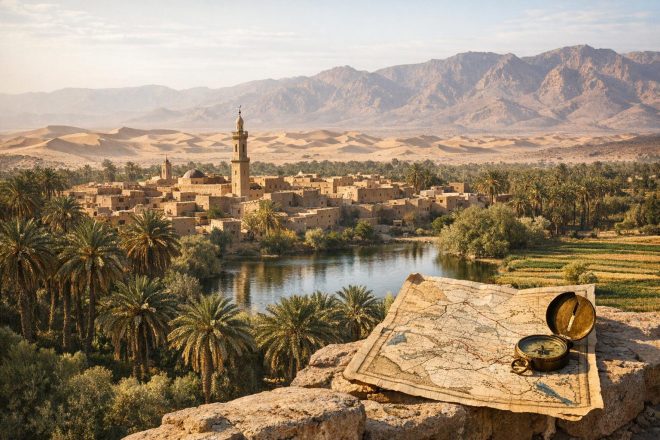
Across the Inner Asian corridors commonly grouped as the Silk Road, oasis towns functioned as the decisive nodes that made long-distance exchange possible. Maps tend to privilege routes, tracing elegant lines across deserts and mountains, but these lines obscure the fact that movement depended on a chain of habitable anchors. Without reliable access to water, fodder, and political protection, caravans could not traverse the arid expanses between East Asia, Central Asia, and the Middle East. What appears, in retrospective cartography, as a continuous network was in practice a sequence of interruptions, pauses, and recalibrations. Each oasis represented not simply a stopping point but a necessary condition of possibility for mobility itself. These settlements imposed rhythm on trade, defining the tempo of movement and structuring the very logic of interregional exchange.
The idea of a “route” is therefore somewhat misleading when applied to Inner Asia. Caravans did not move in uninterrupted motion from one imperial center to another; rather, they proceeded from one ecological niche to the next, recalculating risks and opportunities at each stage. The distance between oases was often the maximum sustainable range of pack animals under specific climatic conditions. Thus, geography dictated not only where towns emerged but also how they were spaced in relation to one another. The Silk Road, in this sense, was less a road than a network of viable habitats embedded within otherwise inhospitable terrain.
Ecology as Infrastructure
The geographical distribution of oasis settlements followed hydrological realities rather than political borders. In regions such as the Tarim Basin, rivers descending from glaciated mountains dissipated into desert basins, creating pockets of arable land. Towns like Khotan, Turfan, and Kucha were not incidental stops; they were ecological prerequisites for transcontinental exchange. Their existence depended on fragile and highly localized water systems, fed by snowmelt and maintained through irrigation technologies that required continuous labor and coordination.
In Turfan, for example, the development of karez systems—subterranean channels designed to transport water from distant aquifers—represented a significant technological adaptation to arid conditions. These systems minimized evaporation and enabled sustained agricultural production in otherwise inhospitable environments. The maintenance of such infrastructure was a collective endeavor, requiring social organization and regulatory norms that governed access to water. In this way, ecology and society were tightly intertwined, with environmental constraints shaping institutional arrangements.
Seasonality played an equally important role. The timing of caravans was often dictated by fluctuations in river flow and temperature. Spring meltwater expanded the capacity of certain routes, while winter conditions, though harsh, could facilitate movement across frozen terrain in some regions. Summer heat, by contrast, could render certain stretches nearly impassable. Oasis towns functioned as buffers against these uncertainties, allowing merchants to wait for favorable conditions or reorganize their caravans. They were, in effect, logistical stabilizers embedded within a volatile environment.
This ecological dimension complicates the notion of infrastructure as something exclusively constructed by human agency. In the Silk Road context, infrastructure was as much about aligning with natural systems as it was about building roads or walls. The availability of water determined not only where people could live but also how far goods could travel. The limits of ecology thus defined the limits of connectivity.
Political Mediation and Security
Oasis towns also served as intermediaries between imperial centers and mobile groups. Local rulers extracted taxes, maintained caravanserais, and negotiated with nomadic confederations that controlled surrounding steppe or desert routes. Their authority was often contingent and negotiated, which gave them leverage disproportionate to their size. Control over even a single oasis could shift regional trade patterns by redirecting caravans through more secure or less costly paths.
Political authority in these regions rarely took the form of absolute sovereignty. Instead, it was layered and situational. An oasis ruler might acknowledge the suzerainty of a distant empire while simultaneously negotiating with nearby nomadic groups for safe passage. Tribute, alliances, and marriages were tools used to maintain a delicate equilibrium. This multiplicity of relationships created a flexible but unstable political environment, in which power was constantly renegotiated.
Caravan security was a central concern. Banditry, extortion, and conflict posed persistent threats to merchants. Oasis authorities responded by providing guarded accommodations, often in the form of caravanserais, and by facilitating agreements with groups controlling adjacent territories. These services were not purely altruistic; they were revenue-generating mechanisms that reinforced the economic centrality of the oasis. By offering relative safety, a town could attract traffic, thereby increasing its fiscal and political significance.
Imperial powers, including the Tang dynasty, the Abbasid Caliphate, and later the Mongol Empire, recognized the importance of these nodes and sought to incorporate them into broader administrative systems. However, direct control was often difficult to sustain. Distance, terrain, and limited communication technologies constrained imperial reach. As a result, oasis towns retained a degree of autonomy, functioning as semi-independent actors within larger geopolitical frameworks.
Commercial Specialization
Contrary to the image of passive waypoints, many oasis towns developed specialized production. Khotan was known for jade and silk weaving; Samarkand became a center for textile production and paper-making. These activities meant that value was added locally rather than merely transferred. The result was a network of interdependent micro-economies rather than a simple chain of relay stations.
The economic life of these towns was shaped by both local resources and transregional demand. Khotan’s access to jade deposits in nearby riverbeds allowed it to supply a material highly prized in Chinese court culture. Similarly, Samarkand’s artisans adapted techniques from multiple regions, producing goods that appealed to a wide range of markets. This capacity for adaptation was a defining feature of oasis economies.
Trade was not limited to luxury goods. While silk, spices, and precious stones have captured historical imagination, bulk commodities such as grain, textiles, and metal goods were equally important. Oasis towns often functioned as redistribution centers, facilitating the movement of these goods across ecological zones. Their markets brought together producers and consumers from diverse backgrounds, creating complex systems of exchange that operated at multiple scales.
Credit and finance also played a role. Merchants frequently relied on partnerships, loans, and other financial instruments to manage the risks associated with long-distance trade. Oasis towns provided the institutional context in which such arrangements could be negotiated and enforced. Trust, reputation, and community networks were critical to these processes, underscoring the social dimensions of economic activity.
Cultural Transmission
The concentration of diverse populations in confined, resource-dependent areas facilitated cultural and religious exchange. Buddhist monasteries in Dunhuang, for example, functioned not only as spiritual centers but also as repositories of manuscripts and art. The transmission of technologies such as papermaking moved westward through these nodes, while artistic motifs and religious ideas moved in multiple directions. Archaeological findings from sites like Dunhuang illustrate how dense and layered these exchanges were.
Oasis towns were multilingual environments. Merchants, pilgrims, soldiers, and administrators brought with them a variety of languages and scripts. This linguistic diversity necessitated translation and fostered the development of intermediary cultures capable of bridging different traditions. Sogdian merchants, in particular, played a significant role in facilitating communication across regions, serving as cultural brokers as well as economic agents.
Religious pluralism was another defining feature. Buddhism, Islam, Zoroastrianism, Christianity, and local belief systems coexisted within these المدن. This coexistence was not always harmonious, but it created opportunities for syncretism and intellectual exchange. Monasteries, mosques, and temples often served as both religious and social institutions, providing services to travelers and participating in local economies.
Artistic production reflects this intercultural interaction. Murals, textiles, and manuscripts from oasis sites display a fusion of styles and motifs, drawing on influences from multiple regions. These artifacts provide valuable insights into the ways in which ideas circulated and were reinterpreted in new contexts. Cultural transmission was not a one-way process but a dynamic exchange shaped by local conditions and preferences.
Temporal Rhythms and Mobility Constraints
The movement of caravans was governed by temporal rhythms that were closely tied to environmental and social factors. Travel schedules had to accommodate not only climatic conditions but also market cycles and political developments. Merchants often planned their journeys to coincide with fairs or periods of relative stability. Delays were common, and flexibility was essential.
Animal capacity imposed additional constraints. Camels, horses, and other pack animals required rest, water, and الغذاء. Their endurance determined the maximum distance that could be covered between stops. Overloading or mismanagement could result in loss of goods or الحيوان itself, with significant economic consequences. Oasis towns provided the necessary الموارد to sustain these animals, reinforcing their centrality to the system.
The cumulative effect of these factors was a pattern of movement characterized by توقفات متكررة rather than continuous travel. Goods often changed hands multiple times before reaching their final destinations, with each transaction adding value and introducing variability. This segmented structure complicates attempts to reconstruct trade flows but underscores the أهمية of local contexts in shaping broader networks.
Relevance to Contemporary Corridors
Modern initiatives often described as a “New Silk Road,” including China’s Belt and Road Initiative, similarly depend on nodal points rather than continuous corridors. Logistics hubs, dry ports, and special economic zones function as contemporary equivalents of oasis towns. Projects in places such as Khorgos on the China-Kazakhstan border highlight how infrastructure concentration still shapes trade flows more than abstract route planning.
These modern nodes are characterized by high مستويات من الاستثمار في النقل والتخزين والتخليص الجمركي. They integrate rail, road, and sometimes maritime networks, enabling the efficient transfer of goods across long distances. Like their historical counterparts, they serve as نقاط تنظيمية where flows are consolidated, processed, and redistributed. Their success depends not only on physical infrastructure but also on regulatory frameworks and political stability.
However, there are महत्वपूर्ण differences as well. Contemporary technologies have reduced some of the environmental constraints that shaped historical trade. Refrigeration, containerization, and advanced logistics systems allow for greater سرعة and predictability. Yet, the fundamental principle remains: long-distance exchange relies on strategically located nodes that mediate between different مناطق and systems.
Geopolitically, these nodes can become sites of competition and cooperation. States seek to control or influence them in order to enhance their own connectivity and economic prospects. This dynamic echoes historical patterns, in which control over key oases conferred disproportionate power. The stakes are different, but the underlying logic is استمرار rather than departure.
Limits of Cartographic Representation
Standard cartographic depictions flatten variability. They imply continuous movement across vast distances, when in reality trade advanced in stages defined by the carrying capacity of animals, the availability of water, and the political climate of each oasis. The apparent linearity of Silk Road maps therefore underrepresents the discontinuous and negotiated nature of historical mobility.
Maps are أدوات abstraction. They simplify complex realities in order to make them legible. In doing so, they often obscure the عوامل التي actually determined how trade functioned. The emphasis on routes can lead to an overestimation of connectivity and an underestimation of friction. By focusing on lines, maps divert attention from the spaces in between—spaces that were often inhospitable and required careful navigation.
A more accurate representation would emphasize nodes and their relationships rather than continuous paths. Such an approach would highlight the أهمية of توقفات and transitions, as well as the variability inherent in the system. It would also draw attention to the ways in which local conditions shaped broader patterns.
Continuity and Fragility
Recognizing the centrality of oasis towns shifts analysis away from routes as static lines and toward networks shaped by environment, governance, and localized economies. This perspective better explains both the resilience and fragility of long-distance exchange systems across Eurasia. Oasis towns enabled trade by providing necessary resources and mediation, but their dependence on fragile ecological and political شرایط made the system susceptible to disruption.
Drought, conflict, or shifts in political alliances could render a particular node inaccessible, forcing merchants to seek alternative paths. Such adjustments could have cascading effects, altering trade patterns across wide regions. The system’s flexibility allowed it to adapt, but this adaptability came at the cost of stability. استمرار was achieved through constant recalibration rather than fixed انتظام.
In this sense, the Silk Road was neither a singular entity nor a stable network. It was an evolving مجموعه of روابط shaped by changing conditions. Oasis towns were the نقاط where these relationships were negotiated and sustained. Understanding their role provides a more nuanced view of how long-distance exchange operated, both in the past and in contemporary contexts.