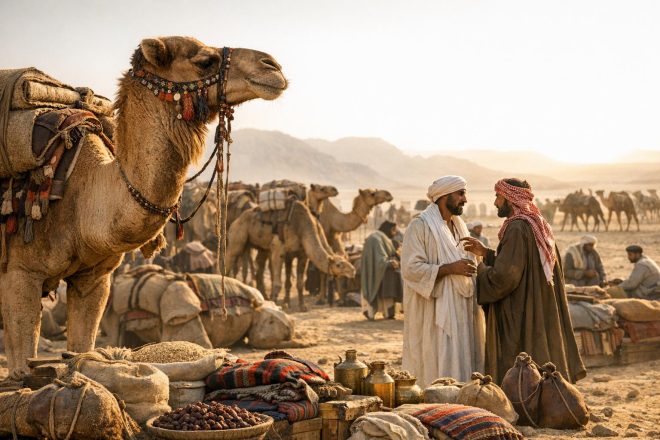
The Camel Trade and Its Central Role in Transcontinental Exchange
The development of long-distance trade across arid regions of Eurasia depended heavily on the domestication and systematic management of camels. By the early first millennium BCE, both the dromedary (single-humped) in the Arabian Peninsula and the Bactrian camel (double-humped) in Central Asia had become indispensable to caravan transport. Their physiological adaptations—including the capacity to conserve water efficiently, tolerate extreme diurnal temperature shifts, and carry substantial loads over extended distances—made them uniquely suited to the ecological constraints of desert and steppe environments. In regions where rainfall was unpredictable and permanent infrastructure was sparse or absent, camels allowed for sustained economic activity across otherwise prohibitive terrain.
The integration of camels into human economic systems marked a turning point in Afro-Eurasian connectivity. Prior to their widespread domestication, trade across deserts such as the Arabian Desert or the Taklamakan Basin was limited, fragmented, and often seasonal. The camel transformed these constraints into manageable variables. This did not eliminate risk, but it allowed for the regularization of routes, the scaling of commerce, and the extension of exchange networks across thousands of kilometers.
Domestication and Environmental Adaptation
The domestication of camels occurred in distinct ecological and cultural zones, reflecting the divergent characteristics of the two primary species. The dromedary camel emerged as the dominant species in the Arabian Peninsula and the broader Near East. Its adaptation to high heat and its ability to travel long distances without water made it especially valuable for crossing the vast deserts of Arabia and North Africa. Archaeological and textual evidence suggests that its domestication was well underway by the late second millennium BCE, though its large-scale integration into trade networks accelerated later.
The Bactrian camel, by contrast, was domesticated in Central Asia, likely in regions corresponding to modern-day Kazakhstan, Mongolia, and northwestern China. Its thick coat, robust build, and capability to endure freezing temperatures distinguished it from its dromedary counterpart. This made it particularly suited to the continental climate of Central Asia, where winters could be severe and terrain often included mountainous passes and high-altitude plateaus.
These differing adaptations allowed the two camel species to complement each other across a broad geographic continuum. In some transitional zones, such as parts of Iran and eastern Central Asia, hybrid camels were bred to combine the endurance of the dromedary with the strength and cold resistance of the Bactrian. Such practices reflect a sophisticated understanding of animal husbandry and a practical response to diverse environmental conditions.
Camels as Infrastructure of Trade
Camels functioned as more than transport animals; they formed a mobile system of infrastructure that underpinned long-distance commerce. A typical caravan could include hundreds of camels, organized in lines or clusters, each animal carrying between 150 and 300 kilograms of goods depending on terrain and duration of travel. The organization of these caravans required careful planning, including the allocation of water resources, calculation of travel distances, and coordination with seasonal weather patterns.
The predictability of camel movement allowed for the gradual establishment of fixed trade routes. These routes were not static roads in the modern sense but dynamic corridors shaped by environmental constraints and political conditions. Along these corridors, waystations developed at intervals determined by access to water and pasture. Some of these stations evolved into major urban centers, including oasis cities such as Palmyra, Merv, and Kashgar, which served as hubs for trade, taxation, and cultural exchange.
The role of camels in maintaining these systems cannot be overstated. Their endurance allowed caravans to bypass the need for frequent resupply, while their ability to carry heavy loads reduced the number of animals and personnel required for a given volume of goods. This efficiency lowered the relative cost of long-distance trade and made possible the exchange of not only luxury goods but also bulk commodities in certain contexts.
Logistics, Route Management, and Risk
The operation of caravan trade involved complex logistical considerations. Caravan leaders, often referred to as caravan masters, needed to possess detailed knowledge of terrain, water sources, and political boundaries. Navigation relied on both environmental cues and accumulated knowledge passed down through generations. Errors in route selection or miscalculations in water provisioning could result in catastrophic losses.
Seasonality played a critical role in determining the timing of caravan movements. In many regions, travel was concentrated in periods when temperatures were moderate and pastures were available. In Central Asia, this often meant avoiding the harshest winter months, while in the Arabian Peninsula, extreme summer heat could similarly constrain movement. These seasonal rhythms contributed to the cyclical nature of trade and influenced the scheduling of markets and fairs.
Risk was an inherent aspect of caravan trade. Threats included not only environmental hazards such as sandstorms and drought but also human factors, including banditry and political instability. The presence of camels mitigated some environmental risks by increasing the resilience of caravans, but it did not eliminate uncertainty. This contributed to the development of mechanisms for risk management, including the formation of large caravans for mutual protection and the use of armed escorts in particularly dangerous regions.
Economic and Political Implications
The camel trade extended beyond transportation into broader economic systems involving breeding, training, and exchange of animals. Control over camel herds represented a form of wealth that could be mobilized in both economic and military contexts. In many nomadic societies, camels served as a primary measure of status and a key component of pastoral economies.
Nomadic groups played a crucial intermediary role in the functioning of transcontinental trade. Their intimate knowledge of terrain, combined with their expertise in camel management, positioned them as indispensable participants in caravan networks. Rather than existing on the margins of settled societies, these groups were deeply integrated into regional economies. They provided logistical services, facilitated exchanges, and in some cases exerted control over key segments of trade routes.
States sought to regulate and benefit from these networks. Empires such as the Parthian and Sasanian regimes recognized the economic value of facilitating trade across their territories. By maintaining relative stability and securing key routes, they were able to extract revenue through taxation and customs duties. This required investment in military infrastructure and diplomatic engagement with both nomadic groups and neighboring states.
In East Asia, Chinese dynasties pursued similar objectives. Frontier policies were often shaped by the desire to secure access to Central Asian trade routes and the valuable goods that traversed them. This involved both military campaigns and systems of tribute and alliance. Camels, as the primary means of transport in these regions, were integral to the realization of these policies.
Urbanization and the Growth of Trade Centers
The regular movement of camel caravans contributed to the development of urban centers along trade routes. Oasis cities, in particular, emerged as critical nodes in the network. These settlements provided water, food, and shelter for caravans, as well as facilities for trade and storage of goods. Over time, they developed complex economic structures, including markets, administrative institutions, and cultural establishments.
The growth of these cities was closely tied to their ability to service caravan traffic. Infrastructure such as caravanserais—enclosed spaces designed to accommodate animals and merchants—played a central role. These facilities were often state-sponsored or supported by local elites, reflecting their importance to regional economies. The presence of camels dictated the design of these structures, which needed to accommodate large animals and the logistics of loading and unloading goods.
Urban centers along the Silk Road were characterized by a high degree of cultural diversity. The constant flow of merchants and travelers brought together individuals from different linguistic, religious, and ethnic backgrounds. This diversity was not incidental but a direct consequence of the mobility enabled by camel transport.
Cultural Exchange and Knowledge Transmission
The capacity of camels to sustain long-distance travel facilitated not only economic exchange but also the movement of ideas and knowledge. Religious traditions, including Buddhism, Christianity, and later Islam, spread along the same routes used for trade. Monks, pilgrims, and scholars relied on caravan networks to travel between regions, carrying with them texts, teachings, and cultural practices.
The transmission of technology followed similar patterns. Innovations in areas such as metallurgy, agriculture, and textile production moved across Eurasia through sustained contact between different societies. Camels enabled the continuity of these interactions by providing a reliable means of transport across vast distances.
Language and art were also influenced by these exchanges. The interaction of different cultures in caravan cities led to the development of hybrid forms of expression. Artistic motifs, linguistic borrowings, and administrative practices reflect the interconnected nature of these regions. While camels were not the direct agents of these changes, their role in enabling movement was fundamental.
Military Uses and Strategic Considerations
In addition to their economic significance, camels had important military applications. They were used for transporting supplies, equipment, and personnel across difficult terrain. In some cases, camels were incorporated into military units, particularly in desert regions where their endurance offered strategic advantages.
The control of camel resources could influence the outcomes of conflicts. Armies that had access to large numbers of camels were better equipped to operate in arid environments, sustain longer campaigns, and maintain supply lines. This made camel herds a strategic asset and a target in warfare.
States also recognized the importance of securing trade routes that depended on camel transport. Military outposts, fortifications, and patrol systems were established to protect caravans and ensure the continuity of commerce. The intersection of economic and military priorities is evident in the allocation of resources to these efforts.
Technological and Administrative Developments
The reliance on camel caravans encouraged the development of administrative systems to manage trade. Record-keeping, taxation, and regulation of markets required bureaucratic structures capable of handling complex transactions. These systems varied across regions but shared common features related to the organization of long-distance commerce.
Technological innovations were often geared toward improving the efficiency of transport. This included advancements in saddle design, harnessing techniques, and load distribution. Such improvements enhanced the capacity and endurance of camels, further reinforcing their central role in trade.
The standardization of weights and measures, as well as the use of currency, facilitated exchange across different regions. These developments were interconnected with the operation of caravan networks and contributed to the integration of diverse economies.
Decline and Transformation
The prominence of camel-based trade systems began to decline with the advent of maritime trade routes and later with the introduction of mechanized transport. Sea routes offered lower costs and greater capacity for bulk goods, gradually reducing the relative importance of overland routes. In the modern era, railways, roads, and air transport have further diminished the role of camels in long-distance commerce.
Despite this decline, camels have not disappeared from economic life. In many regions, they continue to be used for transport, agriculture, and tourism. Their cultural significance also persists, reflecting a long history of human-animal interaction.
Continuity into the Modern Geopolitical Context
The historical patterns established by camel-based trade continue to influence contemporary geopolitics. Modern initiatives often described as a “New Silk Road” reflect an effort to revive and expand transcontinental connectivity. While the technologies involved are fundamentally different, the underlying geographic constraints remain. Routes are still shaped by terrain, climate, and the distribution of resources.
Infrastructure projects across Eurasia frequently align with historical corridors that were once traversed by camel caravans. These corridors represent not only the most practical routes across difficult landscapes but also zones of historical interaction and exchange. Understanding the role of camels in shaping these routes provides valuable context for analyzing current developments.
The legacy of the camel trade is also evident in the cultural and economic ties that persist across regions. These connections, forged over centuries of interaction, continue to influence patterns of cooperation and competition. While camels themselves play a limited role in modern transport, the systems they enabled have left a lasting imprint on the structure of transcontinental exchange.
Conclusion
The camel trade was a foundational component of long-distance commerce across Eurasia. Its significance lies not only in the practical function of transporting goods but also in its broader impact on economic systems, political structures, and cultural exchange. By enabling sustained interaction across vast and challenging environments, camels facilitated the development of interconnected networks that shaped the course of history. The legacy of these systems continues to inform contemporary discussions of trade, infrastructure, and geopolitical strategy.