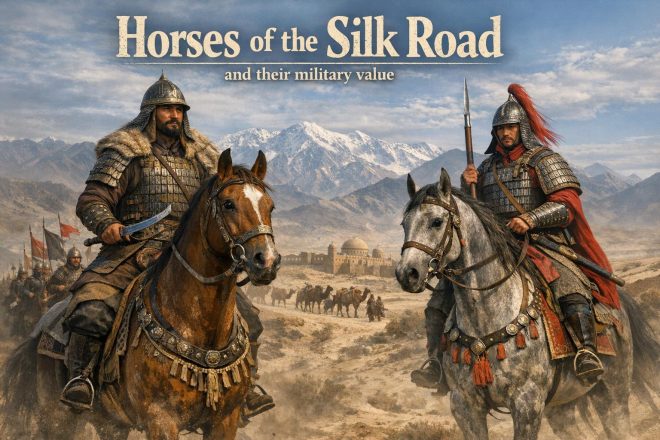
Horses of the Silk Road and Their Military Value
The development of long-distance exchange networks across Eurasia was closely tied to the movement, breeding, and strategic management of horses. Across the vast interconnected systems retrospectively labeled as the Silk Road, horses were not merely items of trade but instruments of power that profoundly influenced military organization, imperial expansion, and diplomatic engagement. Their value extended beyond transport; horses were embedded in systems of taxation, tribute, warfare, and statecraft. Regions such as the Ferghana Valley, the Eurasian steppe, Mongolia, and northern China became crucial centers of equine production, each contributing breeds shaped by localized ecological conditions and distinctive cultural priorities.
Understanding the significance of horses along the Silk Road requires integrating environmental, political, and technological perspectives. The horse functioned simultaneously as a biological resource, a military technology, and a diplomatic currency. Its importance cannot be reduced to battlefield effectiveness alone; horses structured the rhythms of nomadic life, informed imperial logistics, and facilitated the transmission of both material goods and military ideas across thousands of kilometers.
Steppe Ecology and the Emergence of Horse Cultures
The Eurasian steppe, extending from the Hungarian plain to Manchuria, constituted one of the largest continuous grassland ecosystems in the world. Its semi-arid climate, seasonal variability, and expansive grazing lands created ideal conditions for pastoral nomadism. The ecological constraints of this environment encouraged mobility rather than sedentary agriculture, and the domestication of the horse became the central adaptation that allowed human communities to exploit these landscapes effectively.
From an early period, steppe societies developed cultures in which the horse was integral to daily life. Unlike agrarian societies, where animals were often subordinate to crop production, steppe communities organized themselves around herds. Horses provided transportation, milk, meat, and materials such as hides and hair. More importantly, they enabled a form of mobility that transformed both economic and military possibilities. A mounted individual could traverse distances that would take infantry days to cover, effectively compressing space and allowing decentralized groups to maintain cohesion across vast territories.
Nomadic confederations such as the Scythians, Xiongnu, Turkic khaganates, and later the Mongols exemplify how ecological conditions and equine culture combined to produce formidable military systems. These societies were not static; they were politically dynamic entities capable of rapid expansion and fragmentation. Horses allowed leaders to assemble large, mobile armies that could strike quickly, withdraw when necessary, and adapt to changing conditions. This flexibility often placed sedentary states at a disadvantage, particularly when those states lacked sufficient cavalry forces of their own.
The breeding practices of steppe peoples reflected their environmental context. Horses needed to survive harsh winters, subsist on sparse vegetation, and endure long periods without supplementary fodder. Selection favored traits such as stamina, resilience, and surefootedness. While these animals were generally smaller than some of their agrarian counterparts, their endurance made them exceptionally suited to sustained campaigns. Riders often maintained multiple mounts, rotating between them to preserve strength, which allowed armies to maintain high operational tempo over extended distances.
The Ferghana Horses and Chinese Demand
Within this broader equine landscape, certain regions gained reputations for producing superior breeds. The Ferghana Valley, located in present-day Central Asia, emerged as one of the most renowned centers of horse breeding in antiquity. The horses from this region were described in Chinese historical sources as exceptionally powerful and capable of enduring prolonged exertion. Their association with the term “heavenly horses” reflects both their perceived physical qualities and the symbolic value attributed to them.
During the Han dynasty, the Chinese state confronted ongoing military pressure from the Xiongnu confederation, whose mobility and cavalry tactics challenged the defensive capabilities of the empire. Chinese forces, traditionally more reliant on infantry and chariots, recognized the need to adapt. This recognition drove a strategic effort to acquire high-quality horses that could support a more effective cavalry arm.
The resulting campaigns, often referred to as the War of the Heavenly Horses in the second century BCE, demonstrate the extent to which equine resources could shape imperial policy. The Han court dispatched military expeditions deep into Central Asia, not merely to expand territorial influence but to secure access to superior horses. These campaigns required complex logistical planning, including supply lines across arid regions and coordination with local polities.
The acquisition of Ferghana horses had both practical and symbolic consequences. Practically, it contributed to the strengthening of Chinese cavalry forces, enabling more effective countermeasures against nomadic adversaries. Symbolically, it reinforced the image of imperial authority extending beyond traditional boundaries. The integration of Central Asian horses into Chinese military systems also facilitated increased contact between regions, contributing to the broader development of trans-Eurasian networks.
Cavalry Systems and Tactical Innovation
The spread of cavalry warfare across Eurasia was not a uniform process but a series of adaptations and innovations shaped by regional conditions and interactions. Early mounted warfare relied heavily on the combination of mobility and projectile weapons, particularly the composite bow. Constructed from layered materials such as wood, horn, and sinew, the composite bow provided significant power and range while remaining compact enough for use on horseback.
Mounted archery became a defining feature of steppe warfare. Riders could approach enemies at speed, release arrows with precision, and withdraw before counterattacks could be organized. This form of combat required extensive training, as riders needed to maintain balance, control their mounts, and aim accurately under dynamic conditions. The effectiveness of such tactics is evident in encounters between steppe forces and settled empires, where heavily armored infantry often struggled to respond to highly mobile opponents.
Technological developments further enhanced cavalry capabilities. The introduction and eventual widespread adoption of the stirrup represented a significant transformation. By providing a stable platform for the rider’s feet, the stirrup allowed for greater control and the ability to deliver more powerful strikes with weapons such as lances and swords. While the timing and origins of the stirrup remain subjects of scholarly discussion, its impact on medieval warfare is widely acknowledged.
Saddle design also evolved to support different types of cavalry. High-backed saddles offered additional support, enabling riders to maintain stability during rapid maneuvers. These innovations collectively contributed to the diversification of cavalry roles, including light cavalry for reconnaissance and harassment, and heavy cavalry for shock engagements.
Empires that successfully integrated these elements into their military systems gained substantial advantages. The Parthian Empire’s use of mounted archers, combined with heavily armored cavalry, allowed it to defeat Roman forces in several engagements. The Tang dynasty in China developed a balanced approach, incorporating both steppe-derived techniques and indigenous innovations. Meanwhile, the Mongol Empire achieved an unprecedented level of integration, combining superior mobility with disciplined command structures, intelligence gathering, and coordinated operations across multiple fronts.
Logistics, Remount Systems, and Operational Reach
The effectiveness of cavalry forces depended not only on individual skill and equipment but also on the management of equine resources at scale. Large armies required vast numbers of horses, not only for combat but also for transport and communication. Maintaining these animals presented logistical challenges that shaped military organization and state policy.
One key aspect was the development of remount systems. Steppe warriors frequently maintained several horses per rider, allowing them to switch mounts during campaigns and thereby sustain high speeds over long distances. This practice reduced fatigue among animals and increased operational endurance. In contrast, sedentary states often struggled to maintain comparable systems, as their agricultural economies were less suited to large-scale horse breeding.
States that recognized the importance of horses implemented various measures to secure supply. These included establishing state-controlled breeding programs, imposing taxes or tribute in the form of horses, and engaging in trade with nomadic groups. The Chinese “tea-for-horses” trade in later periods exemplifies how economic and military needs were intertwined, with essential commodities exchanged to ensure a steady supply of cavalry mounts.
Infrastructure also played a role. Relay systems, consisting of stations stocked with fresh horses, enabled rapid communication across long distances. Such systems were particularly important for empires managing extensive territories, as they allowed for the transmission of orders, intelligence, and administrative information. The Mongol Yam system represents one of the most sophisticated examples, facilitating communication across Eurasia at unprecedented speeds for its time.
Economic and Diplomatic Dimensions
Horses occupied a central place in the economic networks of the Silk Road. They were not only traded as commodities but also functioned as units of value and instruments of negotiation. Their exchange connected diverse regions, linking nomadic producers with agrarian consumers. This interdependence had significant implications for both economic stability and political relations.
For nomadic societies, horses were both a source of wealth and a means of maintaining social status. The size and quality of one’s herd could influence social standing and political influence. Trade with settled societies provided access to goods that were not readily available in the steppe, such as textiles, grains, and manufactured items. In this context, horses were often exchanged for commodities like silk, which in turn could be redistributed within nomadic networks or used in further trade.
Diplomatically, horses played a prominent role in gift-giving and tribute. The presentation of high-quality horses could signify respect, alliance, or submission, depending on the context. Such exchanges were often carefully orchestrated to convey specific political messages. For example, the transfer of horses from a nomadic ruler to an imperial court could be interpreted as both a gesture of goodwill and a demonstration of the giver’s resources.
These interactions were not always symmetrical. Power imbalances could shape the terms of exchange, with stronger states imposing demands for tribute or controlling access to trade routes. However, even dominant empires had to recognize the strategic importance of maintaining stable relations with horse-producing regions. Disruptions in supply could have immediate military consequences, highlighting the interconnected nature of economic and political systems along the Silk Road.
Cultural Exchange and the Symbolism of Horses
Beyond their practical functions, horses held significant cultural and symbolic meanings across Eurasia. Artistic representations, literary references, and ceremonial uses of horses reflect their importance in various societies. In many steppe cultures, horses were associated with concepts of freedom, mobility, and power. Burial practices often included horses or horse-related artifacts, indicating their role in both life and afterlife beliefs.
In China, horses became symbols of military strength and imperial ambition. Artistic depictions from the Tang dynasty, for example, often portray horses with dynamic energy, emphasizing their role in both warfare and ceremonial display. The cultural exchange facilitated by the Silk Road contributed to the diffusion of artistic styles and equestrian traditions, blending influences from different regions.
Religious and mythological traditions also incorporated horses in various ways. They could serve as divine messengers, companions to deities, or representations of cosmic forces. These symbolic dimensions further reinforced the importance of horses, embedding them deeply within the cultural fabric of Eurasian societies.
Transition and Transformation in the Early Modern Period
The role of horses in warfare began to change with the introduction and proliferation of firearms. While cavalry remained important for several centuries, its dominance gradually diminished as new technologies altered the nature of combat. Nevertheless, horses continued to play essential roles in reconnaissance, communication, and logistics.
In many regions, the integration of firearms did not immediately eliminate the importance of cavalry but rather transformed its function. Mounted troops adapted by incorporating firearms into their tactics, creating hybrid forms of warfare that combined mobility with ranged firepower. Over time, however, the increasing effectiveness of infantry equipped with firearms reduced the relative advantage of cavalry.
Despite these changes, the legacy of equine-based military systems persisted. Many of the organizational principles developed in earlier periods, such as the importance of mobility, logistics, and communication, continued to influence military thinking. The historical experience of managing horse-based armies also informed later developments in transportation and infrastructure.
Continuity into the Modern Context
Although horses no longer occupy a central role in modern military systems, their historical significance continues to shape geopolitical perspectives. The regions that once formed the core of Silk Road networks remain strategically important, and the patterns of connectivity established in earlier periods have enduring influence.
Contemporary initiatives aimed at enhancing regional integration, such as large-scale infrastructure projects, can be understood in part as modern analogues to earlier forms of connectivity. While the technologies involved have changed—from horse-based transport to railways, highways, and digital networks—the underlying logic of linking distant regions for economic and strategic purposes remains consistent.
The historical memory of the Silk Road, including the role of horses within it, contributes to contemporary narratives about cooperation, development, and influence. These narratives are often employed in diplomatic and economic contexts, reflecting the enduring relevance of past interactions in shaping present policies.
Conclusion
Horses of the Silk Road were central to the development of Eurasian history, influencing military systems, economic networks, and political relationships. Their significance derived not only from their physical capabilities but also from the ways in which human societies organized themselves around their use. From the grasslands of the Eurasian steppe to the courts of imperial capitals, horses enabled forms of mobility and interaction that would have otherwise been impossible.
Their impact can be traced across multiple dimensions, including the rise and expansion of empires, the evolution of military tactics, and the establishment of long-distance trade networks. By examining the role of horses, one gains insight into the broader processes that shaped the Silk Road and its legacy. The study of these animals thus provides a lens through which to understand the interconnected history of Eurasia, revealing the complex interplay between environment, technology, and human agency.