The Taklamakan Desert and the Constraints on Early Eurasian Trade
The Taklamakan Desert, situated within the Tarim Basin of present-day Xinjiang, represents one of the most consequential environmental barriers in the historical geography of Eurasia. Its influence extended far beyond its physical boundaries, shaping patterns of trade, political organization, and cultural exchange across centuries. Rather than functioning merely as an obstacle, the Taklamakan actively structured the movement of people, goods, and ideas by imposing strict geographic limitations that traders and states were compelled to navigate.
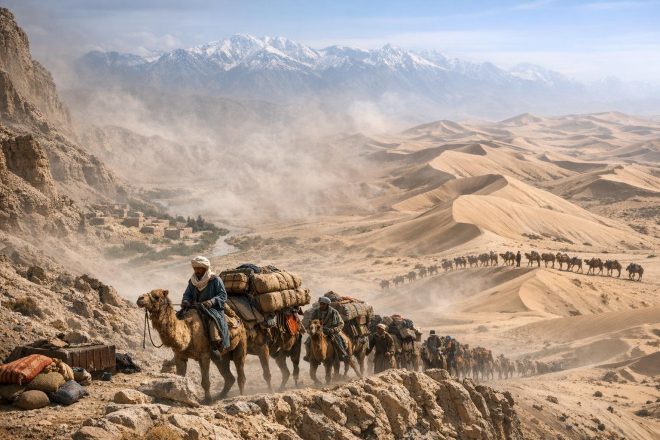
The desert’s defining characteristics—vast expanses of shifting sand dunes, extreme seasonal temperature variation, and a near-total absence of reliable surface water—rendered its interior largely impassable for premodern transport systems. Unlike steppe regions, which could be traversed relatively freely with sufficient knowledge of grazing cycles and seasonal movement, the Taklamakan presented a qualitatively different challenge. It was not a space to cross, but one to circumvent. This fundamental constraint gave rise to the distinctive routing patterns that became synonymous with the Silk Road.
Geographic Barriers and Route Formation
The Taklamakan covers approximately 300,000 square kilometers, making it one of the largest sandy deserts in the world. It is encircled by major mountain systems: the Tian Shan range to the north, the Kunlun Mountains to the south, and the Pamir Plateau to the west. These highlands play a critical hydrological role, as snowmelt and glacial runoff from these ranges feed rivers that dissipate into the basin, enabling the formation of oasis settlements along the desert’s margins.
These oases—including Khotan, Yarkand, Kashgar, Turpan, and Niya—functioned as essential logistical anchors for transcontinental trade. Each settlement depended on localized irrigation systems fed by mountain runoff, creating narrow zones of habitability surrounded by inhospitable desert terrain. The distribution of these oases was uneven, and the distances between them imposed strict limits on caravan capacity and movement.
As a result, two principal corridors emerged. The northern route traced the foothills of the Tian Shan, linking cities such as Turpan and Kucha before connecting westward toward Central Asia. This route benefited from relatively milder climatic conditions and more consistent access to water sources, although it was occasionally exposed to incursions from nomadic groups inhabiting the steppe zones beyond the mountains.
The southern route followed the base of the Kunlun Mountains, passing through settlements such as Khotan and Yarkand. This route was often more arid and required greater logistical preparation. However, it also connected to regions rich in jade and other valuable resources, making it economically significant despite its additional risks.
Attempts to cross the desert interior were exceedingly rare. The absence of stable landmarks, combined with frequent sandstorms that could obscure tracks within hours, rendered navigation highly unreliable. Archaeological evidence suggests that when such crossings were attempted, they often resulted in the loss of caravans. Over time, experiential knowledge reinforced the preference for peripheral routes, embedding these pathways into the long-term structure of Eurasian trade.
Logistical Constraints and Economic Costs
The environmental characteristics of the Taklamakan translated directly into logistical constraints that shaped the scale, speed, and organization of trade. Caravans typically advanced at a pace of approximately 20 to 30 kilometers per day, dictated not only by terrain but also by the physiological limits of transport animals and the spacing of water sources.
The Bactrian camel emerged as the primary pack animal in this environment due to its capacity to endure extreme temperatures and carry substantial loads over long distances without frequent access to water. Even so, caravan management required careful planning. Water had to be rationed precisely, fodder transported or procured at oases, and rest periods scheduled to align with environmental conditions.
These requirements introduced significant costs. Trade across the Tarim Basin was capital-intensive, involving not only the acquisition and maintenance of animals but also the organization of labor and security. Caravans were vulnerable to banditry, particularly in regions where political authority was weak or fragmented. As a result, merchants often traveled in large groups or under the protection of local authorities.
One important consequence of these constraints was the prevalence of segmented trade. Rather than a single merchant transporting goods from East Asia to the Mediterranean, commodities typically changed hands multiple times along the route. Intermediaries played a crucial role, purchasing goods in one region and selling them further along the network. This system distributed risk but also increased cumulative costs, contributing to the high value of luxury goods such as silk, spices, and precious stones.
Pricing structures reflected not only scarcity but also the cumulative logistical burdens imposed by geography. Each transfer added a margin, and each segment involved distinct risks. The Taklamakan, by forcing trade along extended and segmented routes, thereby amplified the economic complexity of long-distance exchange.
Political Control of Oasis States
The configuration of the Silk Road around the Taklamakan elevated the strategic importance of oasis states. Control over these settlements meant control over water sources, rest points, and local markets—all of which were indispensable to caravan trade. As a result, these relatively small and geographically constrained polities assumed outsized significance in regional politics.
During the expansion of the Han Dynasty, Chinese authorities recognized the necessity of securing the Tarim Basin to facilitate trade and counter external threats, particularly from the Xiongnu confederation. Military campaigns were launched to establish influence over key oases, and garrisons were positioned to maintain stability. Diplomatic strategies, including alliances and marriage arrangements, complemented military efforts.
The Tang Dynasty later reinforced this presence, integrating parts of the region into a broader administrative framework. This period is often associated with increased trade activity, as relative stability reduced the risks associated with long-distance travel. However, this stability was not continuous. The region frequently experienced periods of fragmentation, during which local rulers or nomadic groups exerted control over segments of the route.
Such shifts in authority had direct economic implications. Increased tariffs, inconsistent enforcement of security, and the unpredictability of local governance could disrupt trade flows. Conversely, centralized or cooperative governance tended to facilitate commerce by standardizing practices and reducing uncertainty.
It is important to note that political control in this region was rarely absolute. The combination of difficult terrain and dispersed settlements made comprehensive administration challenging. Even major empires relied on negotiated relationships with local elites and communities. This produced a layered political landscape in which authority was shared, contested, and continually renegotiated.
Cultural Exchange Under Environmental Constraint
While the Taklamakan imposed severe physical constraints, it simultaneously concentrated human interaction along specific routes. This concentration fostered significant cultural exchange. Oasis towns became points of sustained contact among diverse populations, including merchants, monks, artisans, and officials.
One of the most notable processes facilitated by these interactions was the spread of Buddhism from South Asia into China. Monastic communities established themselves along the Silk Road, often supported by merchant patronage. Sites such as Dunhuang preserve extensive records of this process, including manuscripts and artwork that reflect a blend of artistic and religious traditions.
Linguistic diversity in the region was considerable. Indo-European languages such as Tocharian coexisted with Turkic languages and forms of Chinese. Scripts and writing systems traveled alongside goods, contributing to the development of administrative and literary practices across Eurasia.
Material culture also reflects this interconnectedness. Textiles, ceramics, and metalwork exhibit stylistic influences that cannot be attributed to a single origin. Instead, they reveal processes of adaptation and synthesis that occurred as artisans and consumers engaged with foreign forms.
The environmental constraints of the Taklamakan played a paradoxical role in this context. By limiting movement to defined corridors, the desert increased the frequency and intensity of interactions within those corridors. Cultural exchange was not diffuse but concentrated, occurring repeatedly in the same locations over extended periods.
Technological and Infrastructural Adaptations
Over time, human communities developed strategies to mitigate, though not eliminate, the challenges posed by the Taklamakan. Irrigation systems, including underground channels known as karez in some areas, allowed for more reliable agriculture in oasis settlements. Caravanserais and fortified rest stations provided shelter and security for travelers.
Advances in cartography and navigational knowledge improved route planning, although these advances remained constrained by the fundamental limitations of the environment. Knowledge was often transmitted orally, with experienced guides playing a crucial role in ensuring safe passage.
These adaptations did not fundamentally alter the structure imposed by the desert but rather optimized movement within its constraints. The persistence of the northern and southern routes over centuries reflects the durability of these adaptations and the absence of viable alternatives.
Continuities in the Modern “New Silk Road”
In contemporary geopolitics, the legacy of the Taklamakan remains evident in initiatives aimed at enhancing Eurasian connectivity. China’s Belt and Road Initiative (BRI) seeks to develop infrastructure networks that facilitate trade across the continent, including railways, highways, and energy corridors that pass through or near the Tarim Basin.
Modern technology has reduced some of the environmental constraints that defined ancient trade. Paved roads, mechanized transport, and advanced surveying techniques enable more direct routes and faster movement. However, these developments require substantial investment and ongoing maintenance, particularly in a region prone to shifting الرمال and extreme climatic conditions.
Moreover, the challenges associated with the Taklamakan have not disappeared; they have been transformed. Infrastructure must contend with sand encroachment, water scarcity, and ecological fragility. Large-scale projects also raise questions about environmental sustainability, particularly in relation to water usage and desertification.
Geopolitical considerations remain central. Xinjiang occupies a strategic position linking East Asia to Central Asia and beyond. As such, it is a focal point for both domestic policy and international interest. Issues related to security, governance, and economic integration affect the implementation and perception of infrastructure projects in the region.
The logic of controlling key nodes persists in a modernized form. Transport hubs, logistics centers, and border crossings function as contemporary equivalents of oasis towns, concentrating flows of goods and information. Just as in the past, their management carries significant economic and strategic implications.
Reassessing the Role of Geography
The case of the Taklamakan Desert illustrates the enduring influence of geography on human systems. While technological advancements have altered the means by which constraints are addressed, they have not eliminated the underlying spatial realities. Instead, they have shifted the balance between constraint and capability.
Historical analysis of the Silk Road demonstrates that environmental barriers can produce structured patterns of interaction that persist over long periods. These patterns are not deterministic, but they shape the range of viable خيارات available to societies.
In the context of the Taklamakan, the necessity of peripheral movement created a network characterized by nodal concentration, segmented exchange, and political competition over limited resources. These characteristics continue to inform contemporary developments, even as the scale and speed of interaction have increased.
Conclusion
The Taklamakan Desert functioned as a defining force in the history of Eurasian trade. Its environmental conditions restricted direct movement while channeling activity into specific corridors, thereby shaping economic systems, political strategies, and cultural exchanges. The resulting network was both constrained and dynamic, reflecting the interplay between geography and human adaptation.
Modern efforts to enhance transcontinental connectivity continue to engage with the same landscape, albeit with different tools and objectives. The persistence of key routes and nodes underscores the long-term significance of geographic constraints. Understanding the historical role of the Taklamakan provides valuable insight into both the origins of the Silk Road and the ongoing evolution of Eurasian integration.