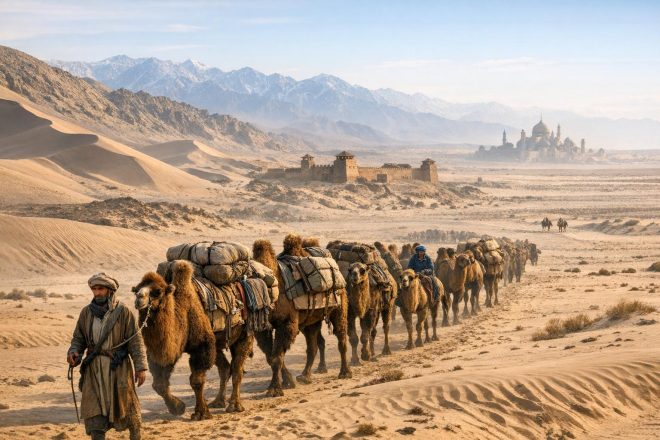
The Gobi Desert exerted a decisive influence on patterns of movement along the Silk Road by constraining routes, shaping logistical practices, and structuring political control across Inner Asia. Extending across present-day Mongolia and northern China, the Gobi is not a uniform sea of sand but a mosaic of gravel plains, rocky outcrops, and sparse steppe. Its environmental characteristics imposed limits that traders, states, and pastoral groups had to accommodate rather than overcome. This interplay between ecology and human activity is central to understanding how the Silk Road developed not as a single road but as a network of corridors whose form was dictated by terrain.
Rather than serving merely as a barrier, the Gobi functioned as a filtering mechanism. It reduced the number of viable pathways, thereby concentrating movement into predictable channels. These channels, in turn, became the foundation for economic exchange, political authority, and cultural transmission across Eurasia. Any historical analysis of Silk Road dynamics that neglects the material realities of the Gobi risks overstating the role of imperial ambition or commercial demand while understating the environmental conditions that made such ambitions viable or untenable.
Environmental Constraints and Route Formation
The Gobi’s defining features—aridity, low precipitation, wide temperature fluctuations, and limited vegetation—placed stringent limits on sustained human movement. Unlike sandy deserts such as the Taklamakan, parts of the Gobi are composed primarily of gravel plains and hard-packed earth, which can support travel more effectively but offer little in terms of water or forage. These characteristics forced travelers to align their routes with a small number of reliable ecological nodes.
Water availability was the most decisive factor. Wells, springs, and seasonal streams determined where caravans could reliably pass. Over time, repeated usage reinforced specific corridors, embedding them into the geography of trade. These routes were not arbitrary; they followed a logic shaped by survival. A deviation from known paths could expose a caravan to dehydration or starvation within a matter of days.
The margins of the Gobi became especially significant. Along these transitional zones—where desert gives way to steppe or cultivated land—resources were marginally more abundant. The Hexi Corridor, stretching along the northeastern edge of the Tibetan Plateau, exemplifies this dynamic. It offered a relatively narrow but fertile strip through which goods, armies, and ideas flowed between China proper and Central Asia. Cities such as Dunhuang emerged not by chance but because they occupied points where environmental constraints and human movement intersected.
Routes also evolved over time in response to climatic variation. Periods of increased rainfall could temporarily expand grazing areas and enable alternative paths, while prolonged drought tightened the network further. These fluctuations contributed to the Silk Road’s fluidity; it was never a fixed system but an adaptive one. Even so, the underlying environmental framework remained stable enough to anchor long-term patterns of exchange.
Logistics and Caravan Practices
Movement across the Gobi required careful planning and an intimate understanding of environmental conditions. Caravans were not spontaneous ventures; they were meticulously organized operations in which timing, provisioning, and coordination were critical. Bactrian camels played a central role in enabling this system. Unlike their dromedary counterparts, they were well-suited to colder climates and could endure the temperature extremes characteristic of the Gobi, ranging from scorching summers to freezing winters.
The carrying capacity of these animals allowed merchants to transport bulky goods such as silk, textiles, ceramics, and metalwork over long distances. However, their endurance did not eliminate the need for precise logistical calculations. Travelers had to know the distance between water points, estimate consumption rates, and account for delays caused by weather or terrain. Errors in these calculations could prove fatal, reinforcing a culture of caution and reliance on accumulated knowledge.
Caravan organization reflected these constraints. Groups often traveled in convoys for mutual support, sharing resources and information. Leadership typically fell to individuals with extensive experience of the routes, including local guides who understood seasonal variations and could identify signs of approaching storms or dwindling water sources. Knowledge was transmitted orally and through practice, forming a body of expertise that was as valuable as any physical commodity.
Infrastructure developed in response to these needs. Caravanserais, though more common in regions with greater state investment, appeared at critical نقاط along the desert’s periphery. These establishments offered shelter, storage, and opportunities for trade and negotiation. They also served as hubs for the exchange of information, including news of political conditions, security risks, and market demand. In this sense, logistics extended beyond the physical movement of goods to encompass the circulation of knowledge.
Seasonality shaped all aspects of travel. Summer journeys were limited by heat and water scarcity, while winter travel posed risks associated with cold and snow. As a result, caravans often timed their departures to coincide with periods when environmental conditions were most manageable. This introduced a rhythm to Silk Road commerce, linking economic activity to the annual cycle of the steppe and desert.
Political Control and Security
The geographical concentration of routes along the Gobi’s edges created opportunities for political control. States that could secure these corridors gained access to trade revenues and strategic leverage. For Chinese dynasties, especially during the Han and Tang periods, the Hexi Corridor was of paramount importance. Control over this region allowed them to project power westward and maintain contact with Central Asian polities.
To achieve this, they constructed fortifications, garrison towns, and signaling systems. These installations were not merely defensive; they were instruments of administration and integration. By establishing a presence along key نقاط, the state could regulate movement, collect taxes, and offer protection to merchants. This system contributed to periods of relative stability, during which trade flourished.
At the same time, nomadic confederations exercised their own forms of control. Groups such as the Xiongnu and later the Mongols leveraged mobility and knowledge of the steppe to dominate adjacent مناطق. Their influence extended into the fringes of the Gobi, where they could intercept or protect caravans. Rather than representing a simple dichotomy between nomadic disorder and sedentary order, this dynamic involved complex interactions in which both types of polities engaged in negotiation, alliance, and conflict.
Protection became a commodity in its own right. Caravans often paid tribute or fees to secure safe passage through territories controlled by nomadic groups. In some cases, these arrangements were formalized into systems of mutual benefit, where trade supported political stability. In others, they devolved into predation, with caravans subject to raids or extortion. The balance between these outcomes depended on broader geopolitical conditions, including the strength and cohesion of regional powers.
The Mongol Empire represents a notable example of how centralized control over vast ტერიტორი reshaped Silk Road dynamics. By unifying large portions of Eurasia under a single राजनीतिक framework, the Mongols reduced barriers to movement and enhanced security along key routes. Their administrative practices, including the establishment of relay stations, facilitated communication and commerce across distances that had previously been difficult to traverse.
Interaction Between Nomadic and Sedentary Worlds
The Gobi Desert marked not only an environmental boundary but also a zone of interaction between different modes of life. To its south and east lay الزراعية societies characterized by settled agriculture and urban centers. To its north and west stretched the steppe, inhabited by pastoral nomads whose mobility was essential to their economic system. The interface between these क्षेत्रों produced a dynamic interplay of cooperation and conflict.
Nomadic groups were integral to the functioning of Silk Road networks. Their expertise in managing livestock and navigating harsh environments made them effective intermediaries. They could transport goods across مناطق that sedentary traders found difficult to traverse and often provided logistical support, including animals and guides. In this sense, they acted as facilitators of exchange rather than mere obstacles.
Economic interaction was deeply intertwined with political relations. Sedentary states often sought to secure alliances with nomadic groups, providing goods such as silk in exchange for horses or military support. These exchanges were not purely commercial; they were embedded in systems of diplomacy and tribute. Control over trade routes could influence the balance of power, making the Gobi a গুরুত্বপূর্ণ space in regional politics.
Cultural exchange accompanied these interactions. Ideas, technologies, and religious beliefs moved alongside goods, carried by merchants, envoys, and travelers. The transmission of Buddhism from India into China, for example, involved journeys through oasis towns on the fringes of the Gobi. These الثقافي flows were facilitated by the very constraints that structured physical movement, as repeated use of specific routes created enduring channels of संपर्क.
At times, tensions between nomadic and sedentary societies erupted into conflict, often driven by competition over resources or political dominance. Yet even in such periods, the underlying interdependence remained. The Gobi did not isolate these groups from one another; it brought them into sustained संपर्क under conditions that required adaptation and negotiation.
Technological and Informational Dimensions
While environmental and political factors shaped the broad contours of Silk Road activity, technological and informational developments also played a role in mediating the challenges of the Gobi. Innovations in animal husbandry, saddle design, and load distribution improved the efficiency of caravans. Techniques for locating and preserving water, as well as methods of navigation based on celestial observation or landscape markers, enhanced the reliability of long-distance travel.
Equally important was the accumulation of shared knowledge. Maps in the modern sense were limited, but itineraries, oral traditions, and written accounts provided detailed guidance on routes, संसाधन availability, and संभावित hazards. This body of knowledge reduced uncertainty and allowed merchants to plan with greater confidence, even in an environment as unforgiving as the Gobi.
Information networks extended beyond practical concerns. News of political changes, market conditions, and सुरक्षा risks circulated along the same routes as goods. This flow of information contributed to the integration of distant regions into a broader system of exchange. In this way, the Gobi functioned not only as a physical चुनौती but also as a محور around which informational networks were organized.
Long-Term Geopolitical Implications
The historical influence of the Gobi Desert continues to shape contemporary geopolitics. Modern infrastructure projects across Inner Asia often follow corridors that reflect ancient patterns of movement. Railways, highways, and pipelines are routed along مناطق where environmental constraints are manageable and where historical precedent has demonstrated the feasibility of sustained الاتصال.
China’s Belt and Road Initiative illustrates this استمرار. While driven by modern الاقتصادية and strategic considerations, it aligns in many respects with the geography of the Silk Road. The emphasis on overland corridors عبر Central Asia echoes earlier efforts to link East Asia with western regions through routes that skirt the most inhospitable parts of the Gobi. The استمرار of these patterns underscores the enduring relevance of environmental constraints.
At the same time, technological advances have altered the balance between constraint and capability. Modern transportation systems can traverse distances more rapidly and with greater reliability than historical caravans. However, they do not eliminate the fundamental challenges posed by terrain, জল scarcity, and климат extremes. Instead, they require significant investment in infrastructure and maintenance, reinforcing the strategic importance of specific corridors.
The Gobi also remains a space of political significance. Its مناطق are shared by states with differing interests, and its संसाधन—including minerals and ऊर्जा—are increasingly important in global markets. Control over transportation routes and access to these resources continues to influence regional dynamics, much as control over Silk Road corridors did in earlier periods.
In both historical and modern contexts, the Gobi Desert has not simply obstructed movement; it has structured it. By limiting الخيارات and concentrating traffic, it has defined the geography of exchange across Eurasia. Understanding this भूमिका requires attention not only to human agency but also to the material conditions that shape what is possible. The Silk Road, in all its complexity, was as much a product of the environment as it was of التجارة, السياسة, and संस्कृति.