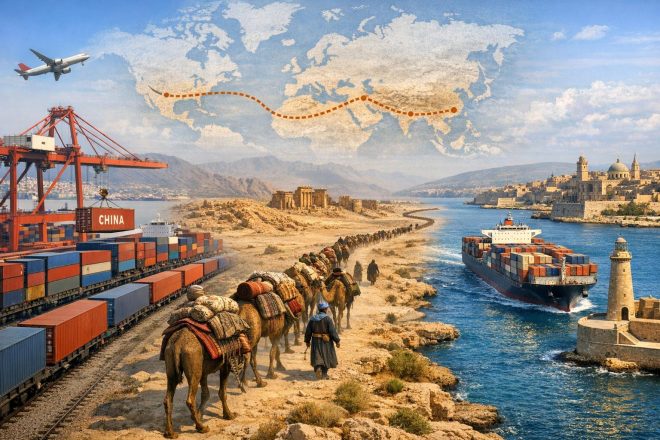
Overland Corridors and Maritime Routes
Goods moved from China to the Mediterranean through a network of overland and maritime routes commonly referred to as the Silk Road system. This system was not a single continuous road but an evolving lattice of interconnected pathways that shifted over time in response to political authority, environmental conditions, and economic demand. Rather than imagining a fixed corridor stretching unbroken from East Asia to Europe, it is more accurate to understand the Silk Road as a set of overlapping circuits, within which merchants, states, and intermediaries played distinct but interdependent roles.
The eastern origins of these routes lay in imperial Chinese capitals such as Chang’an and Luoyang, which functioned not only as administrative centers but also as hubs of production and redistribution. From these cities, goods were transported across the Hexi Corridor, a strategically vital strip of land that provided one of the few viable passages between China proper and the broader regions of Central Asia. This corridor, bounded by mountain ranges and deserts, served as a controlled gateway where imperial authorities could regulate trade, monitor movement, and extract revenue.
Beyond the Hexi Corridor lay the formidable Taklamakan Desert, a geographical barrier that shaped the structure of the overland routes. Caravans rarely crossed the desert directly. Instead, they skirted its edges via northern and southern branches, each lined with oasis settlements sustained by glacial meltwater and rivers descending from surrounding mountain ranges. These oasis cities—Dunhuang, Khotan, Turpan, and others—were critical nodes where goods were exchanged, stored, taxed, and sometimes transformed through local production.
Movement along these routes required constant adaptation. Seasonal variations, availability of water, and political conditions all influenced which paths were considered viable at any given time. The result was a dynamic network in which no single route remained dominant indefinitely. Rather, trade routes expanded, contracted, and shifted in accordance with broader regional developments.
Role of Intermediary Empires
Trade across Eurasia depended fundamentally on the presence of intermediary empires that controlled key segments of the route. These political formations did not merely facilitate trade; they structured it. By providing security, regulating markets, and maintaining infrastructure, states such as the Han dynasty, the Kushan Empire, the Parthians, and later the Sasanians and Byzantines enabled long-distance exchange to occur at scale.
It is important to emphasize that most goods did not travel the entire distance from East Asia to the Mediterranean under the supervision of a single group of merchants. Instead, commodities were exchanged incrementally. A bolt of silk produced in China might pass through numerous hands—Chinese traders, Central Asian intermediaries, Persian merchants, and eventually Mediterranean distributors. At each stage, the value of the goods increased, reflecting both transportation costs and the risks associated with long-distance trade.
The Parthian Empire provides an illustrative example of how intermediary powers shaped trade dynamics. Positioned between the Roman Empire and regions further east, the Parthians effectively controlled access to overland routes linking the Mediterranean with Central Asia. Their political dominance allowed them to act as gatekeepers, often profiting from their ability to regulate the flow of goods and information between competing civilizations.
Similarly, the Kushan Empire played a central role in facilitating connections between South Asia, Central Asia, and China. Its territory encompassed critical segments of the Silk Road, and its rulers actively promoted trade by issuing coinage, supporting urban centers, and maintaining relative stability across diverse regions.
Periods of political fragmentation often resulted in disruptions to trade, as insecurity increased transaction costs and reduced the willingness of merchants to undertake long journeys. Conversely, eras of imperial consolidation tended to enhance connectivity. The expansion of the Mongol Empire in the 13th century is frequently cited as a period of remarkable integration. Under Mongol rule, vast portions of Eurasia were brought under a relatively unified political framework, allowing for safer passage and more efficient communication. This phenomenon, often referred to as Pax Mongolica, did not eliminate risk but significantly reduced it compared to earlier periods.
Caravan Logistics and Goods
The mechanics of overland trade depended on the organization of caravans, which were highly structured enterprises designed to mitigate the risks of long-distance travel. Caravans typically consisted of dozens or even hundreds of animals—camels being the most prominent due to their ability to withstand harsh desert conditions. Horses, mules, and yaks were also used in different terrains, particularly in mountainous regions.
Merchants rarely traveled alone. Instead, they formed caravans for mutual protection and efficiency. Caravan leaders coordinated routes, negotiated with local authorities, and managed provisions. The success of a journey depended on careful planning, including the calculation of distances between water sources and the timing of travel to avoid extreme weather conditions.
The economic logic of overland trade favored goods with high value relative to their weight and volume. Silk is the most well-known example, but it was part of a broader category of luxury items that included spices, precious metals, gemstones, glassware, lacquerware, and fine textiles. These goods could bear the high costs of transportation and the risks associated with long-distance exchange.
Caravanserais formed an essential part of the infrastructure supporting these journeys. Located at regular intervals along major routes, these establishments provided lodging, food, storage facilities, and security. They also functioned as sites of commercial exchange and cultural interaction, where merchants from different regions could meet, negotiate, and share information.
The duration of journeys varied widely. A full journey from eastern China to the Mediterranean might take over a year, often involving multiple stages and changes of personnel. Delays were common, caused by weather, political disturbances, or logistical challenges. Despite these difficulties, the persistence of long-distance trade over centuries demonstrates the strength of demand for the goods being transported.
Maritime Trade Networks
While overland routes have traditionally dominated narratives of the Silk Road, maritime pathways were equally significant, particularly from the early centuries of the Common Era onward. These routes connected southern Chinese ports with Southeast Asia, the Indian subcontinent, the Persian Gulf, and the Red Sea, forming an extensive network of oceanic exchange.
Maritime trade offered several advantages over overland transport. Ships could carry significantly larger quantities of goods, reducing the cost per unit transported. This made it possible to trade not only luxury items but also bulk commodities such as grain, timber, ceramics, and metals. As a result, maritime routes expanded the range of goods involved in long-distance exchange.
The success of Indian Ocean trade depended heavily on knowledge of monsoon wind patterns. Mariners learned to time their voyages according to seasonal winds, allowing for relatively predictable travel between regions. This understanding facilitated regular, cyclical trade networks in which merchants could plan journeys with a higher degree of reliability than was often possible overland.
Ports served as critical nodes in this maritime system. Cities such as Guangzhou in China, Calicut in India, and ports along the Arabian Peninsula became centers of commerce where goods were exchanged, stored, and redistributed. These ports were often cosmopolitan environments, hosting merchants from diverse cultural and linguistic backgrounds.
The integration of maritime and overland routes created a flexible system in which goods could move along multiple pathways. For example, commodities transported by sea to ports in the Persian Gulf or Red Sea could then continue overland to Mediterranean markets. This interconnectivity allowed traders to adapt to changing conditions, shifting between routes as necessary.
Entry into the Mediterranean
The final stages of Silk Road trade involved the entry of goods into the Mediterranean world, where they were distributed across European markets. Key urban centers such as Antioch, Alexandria, and Constantinople functioned as major نقاط of redistribution. These cities were not merely endpoints but active participants in the broader network, linking eastern imports with local economies.
Demand within the Roman and later Byzantine Empires played a significant role in sustaining long-distance trade. Silk, in particular, became a symbol of status and wealth, associated with imperial authority and elite consumption. The high value placed on such goods justified the considerable costs involved in transporting them across vast distances.
Over time, efforts were made within the Mediterranean world to reduce dependence on external sources. The Byzantine Empire, for instance, sought to develop its own silk production after acquiring knowledge of sericulture. This shift illustrates how the circulation of goods was often accompanied by the transfer of technologies and skills.
The Mediterranean phase of the Silk Road was also shaped by regional political dynamics. Control over key cities and trade routes could yield substantial economic benefits, leading to competition among states and empires. Despite these rivalries, the overall system continued to function due to the persistent demand for goods and the adaptability of trade networks.
Geopolitical Shifts and Their Impact
The structure and intensity of Silk Road trade were closely tied to broader geopolitical transformations. The rise of Islamic caliphates in the 7th century introduced a new framework of political and economic integration spanning from the Iberian Peninsula to Central Asia. This expansive realm facilitated trade by providing a relatively unified commercial environment, supported by shared legal practices and financial instruments.
Under Islamic rule, cities such as Baghdad emerged as major centers of commerce and intellectual exchange. The integration of diverse regions within a common political framework allowed for increased movement of goods, people, and ideas. Trade routes were not only conduits for commodities but also for knowledge, including scientific, medical, and philosophical traditions.
Subsequent periods of fragmentation and conflict altered the configuration of trade networks. The decline of Mongol authority, for instance, led to increased insecurity along overland routes. This, combined with technological developments in navigation and shipbuilding, contributed to a gradual shift toward maritime trade as the primary mode of long-distance exchange between Asia and Europe.
By the early modern period, European maritime expansion further transformed global trade patterns. Sea routes around the Cape of Good Hope connected Europe directly with Asia, reducing reliance on traditional overland pathways. Nevertheless, elements of the Silk Road system persisted, particularly within regional networks across Central Asia and the Middle East.
In the contemporary era, the concept of a “New Silk Road” has been revived, most prominently through China’s Belt and Road Initiative. This framework seeks to enhance connectivity across Asia, Europe, and Africa through investments in infrastructure such as railways, highways, ports, and energy pipelines. While the historical Silk Road was not a centrally planned project, the modern initiative reflects a strategic effort by a single state to shape transcontinental networks in accordance with its economic and geopolitical interests.
The comparison between historical and modern forms of connectivity highlights both continuity and change. Geography continues to play a fundamental role, as corridors still follow routes determined by terrain and resource distribution. At the same time, contemporary technologies and political structures enable forms of coordination and scale that were not possible in earlier periods.
Modern overland rail links, for example, allow goods to move between East Asia and Europe in a matter of weeks rather than months or years. Maritime shipping has likewise become more efficient, with containerization revolutionizing the transport of goods. Despite these advances, challenges remain, including political tensions, economic disparities, and concerns about dependency and sovereignty.
The historical Silk Road system provides a useful framework for understanding these developments. It illustrates how long-distance exchange is shaped by a combination of geographical constraints, political authority, economic incentives, and technological capabilities. The interplay of these factors has produced a system that, while constantly changing, retains certain enduring characteristics.
Ultimately, the movement of goods from China to the Mediterranean has never been a linear process. It has always involved multiple routes, actors, and stages, each contributing to a complex and adaptive network. The study of this system offers insights not only into the past but also into the dynamics of contemporary global connectivity.