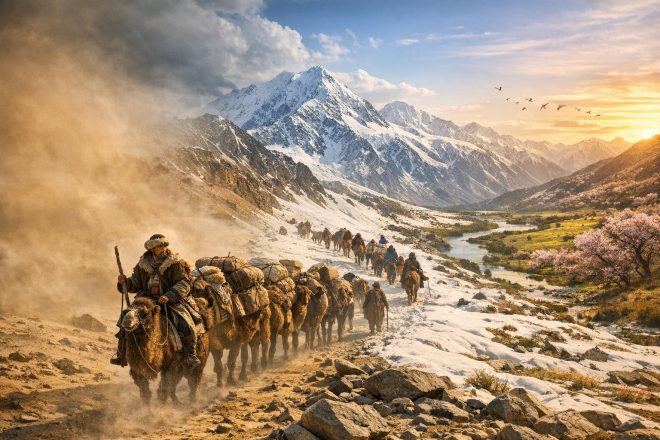
The functioning of the Silk Road was closely tied to environmental constraints. Travel across Eurasia depended not only on political stability and commercial demand, but also on seasonal rhythms and regional weather patterns. Merchants, caravans, and state envoys had to plan their movements around predictable climatic windows, while also managing sudden and often dangerous shifts in temperature, precipitation, and wind conditions. These environmental factors were not merely background conditions; they actively structured the tempo, geography, and organization of long-distance exchange. The Silk Road, when examined closely, appears less as a fixed route and more as a dynamic system of pathways that expanded, contracted, and shifted in response to changing ecological realities.
At a continental scale, Eurasia encompasses a wide range of climatic zones, from Mediterranean coastal environments to continental steppe, high-altitude mountain systems, and hyper-arid deserts. Each of these zones imposed distinct demands on travelers. The success of trade networks depended on the ability of merchants and states to integrate environmental knowledge into logistical planning. Over generations, this knowledge accumulated into shared practices, governing when caravans departed, which routes they selected, how they provisioned themselves, and how they mitigated risks associated with unpredictable weather events.
Seasonal Rhythms and Travel Timing
Caravan traffic along the Silk Road was highly seasonal. This seasonality was not simply a matter of preference but a structural necessity imposed by climate. In much of Central Asia, spring and autumn represented optimal windows for long-distance travel. During spring, melting snow replenished rivers and wells, and newly grown grasses provided essential fodder for pack animals. Autumn offered similarly favorable conditions following summer heat, with stable weather and sufficient grazing lands. These transitional seasons minimized the risks associated with both extreme heat and extreme cold.
Summer travel, particularly across interior basins such as the Tarim Basin, exposed travelers to prolonged heat and aridity. Daytime temperatures in desert regions often exceeded tolerable limits for both humans and animals. Water loss was rapid, and the absence of shade made sustained travel hazardous. Caravans moving in summer frequently adopted nocturnal travel patterns, resting during daylight hours and advancing under cooler nighttime conditions. Even with such adaptations, the margin for error remained narrow, and miscalculations in water supply could prove fatal.
Winter, by contrast, imposed a different set of constraints. In the steppe zones and mountainous regions, temperatures dropped sharply, often well below freezing for extended periods. Snow accumulation limited access to pasture, reducing the availability of grazing. Rivers and smaller water sources froze, complicating resupply. Moreover, winter storms could arise suddenly, reducing visibility and disorienting travelers. Despite these challenges, winter travel was not entirely absent. In some cases, frozen ground facilitated movement across otherwise difficult terrain, but such journeys required specialized preparation and carried significant risk.
Timing, therefore, became a core element of Silk Road logistics. Caravans were frequently organized months in advance, aligning departure dates with anticipated seasonal conditions along multiple segments of a journey. Because routes spanned diverse ecological zones, travelers often had to coordinate transitions between regions with different climatic calendars. A caravan departing from northern China, for instance, needed to consider conditions not only in the Hexi Corridor but also in the deserts of Xinjiang and the high passes leading into Central Asia. Misalignment in timing could result in delays at intermediate points, where travelers were forced to wait for favorable conditions to proceed.
These patterns contributed to the emergence of cyclical trade rhythms. Markets in key nodes along the Silk Road often experienced seasonal surges in activity, corresponding to the arrival of caravans. The periodic nature of these flows influenced price fluctuations, availability of goods, and the organization of local economies. In this way, environmental seasonality shaped not only movement but also commercial structures across Eurasia.
Mountain Corridors and High-Altitude Constraints
Mountain systems such as the Pamir, Tian Shan, and Hindu Kush formed critical yet challenging segments of Silk Road networks. These high-altitude regions acted as both barriers and conduits, channeling movement through a limited number of passes. The usability of these passes was strictly seasonal. Heavy snowfall during winter rendered many routes impassable, while spring avalanches and unstable terrain posed additional hazards.
The opening of mountain passes was a significant annual event in the rhythm of transcontinental trade. Caravans often assembled at staging points near the foothills, waiting for reports that routes were clear. These staging areas evolved into key commercial centers, where goods were exchanged, animals were traded or replaced, and information about route conditions circulated. Cities such as Kashgar gained prominence in part because of their strategic position at the intersection of multiple routes leading through the mountains.
Altitude introduced physiological challenges as well. Reduced oxygen levels affected both humans and animals, decreasing endurance and increasing fatigue. Travelers needed to acclimatize gradually when ascending into high-altitude regions. Rapid ascents could lead to illness or reduced operational capacity, further slowing movement. These factors limited the volume of goods that could be transported across mountainous sections and often required the use of smaller, more specialized caravans.
Weather variability in mountains was particularly unpredictable. Clear conditions could shift rapidly to snowstorms, even during transitional seasons. Narrow passes amplified the impact of such events, as there were limited options for shelter or alternative routes. In response, travelers relied heavily on local guides who possessed detailed knowledge of the terrain, seasonal patterns, and potential hazards. This reliance highlights the integration of environmental expertise into the functioning of Silk Road systems.
Desert Conditions and Wind Systems
The major deserts of the Silk Road corridor presented persistent hazards that required careful planning and adaptation. The Taklamakan Desert, along with parts of the Karakum and Kyzylkum deserts, exemplified some of the most challenging environments encountered by caravan travelers. These regions were characterized by minimal precipitation, sparse vegetation, and extreme temperature fluctuations between day and night.
Water scarcity was the most immediate concern. Routes were structured around a network of oases, where groundwater or surface water was available. The spacing of these oases determined the maximum feasible distance between caravan rest points. Caravans needed to carry sufficient water to traverse these intervals, which imposed limits on cargo capacity. In some areas, wells were constructed or maintained by local authorities to support trade, underscoring the importance of infrastructure in overcoming environmental constraints.
Wind systems played a decisive role in shaping travel conditions. Seasonal winds influenced not only temperature but also the movement of sand. In the Taklamakan, shifting dunes could obscure established paths, making navigation difficult. Over time, travelers developed techniques for maintaining orientation, including the use of fixed landmarks such as distant पर्वत ranges or man-made markers placed along routes. Knowledge of prevailing wind directions allowed experienced guides to anticipate areas of higher risk.
Sandstorms represented one of the most significant hazards. These events could arise with little warning, reducing visibility to near zero and causing disorientation. Fine sand particles could damage goods, infiltrate containers, and affect the health of both humans and animals. During severe storms, caravans often halted and sought shelter, if available, to avoid losing direction. The unpredictability of such events added an element of uncertainty to desert travel that could not be entirely eliminated through planning.
Despite these challenges, desert routes remained integral to Silk Road networks because they offered relatively direct connections between key regions. The existence of multiple parallel routes around the Tarim Basin, for instance, reflects attempts to balance distance with environmental risk. Northern and southern paths offered different combinations of oasis density, climatic conditions, and political control, allowing merchants to choose routes based on prevailing circumstances.
Climate and Animal Logistics
The selection and management of transport animals were central to the adaptation of Silk Road trade to diverse environmental conditions. Different species were suited to specific climates, and their capabilities shaped the structure of caravans. Bactrian camels were particularly valued in Central Asia due to their ability to endure both cold temperatures and arid conditions. Their dual humps stored fat, providing an energy reserve that allowed them to survive extended periods without food. Their thick coats offered protection against winter cold, while their physiological adaptations minimized water loss.
In contrast, dromedary camels were more common in regions further west and south, where climates were warmer. These animals were well adapted to hot desert environments but less suited to cold conditions. The distribution of camel species across the Silk Road reflects broader ecological patterns and the necessity of aligning animal use with regional climates.
Other animals, including horses, mules, and yaks, were also employed depending on terrain and altitude. Horses were valued for speed and were often used for communication and high-value goods, while mules provided versatility in mixed terrain. Yaks, adapted to high-altitude environments, played a crucial role in mountainous regions, where their strength and resilience allowed them to navigate steep and rugged landscapes.
The availability of grazing land influenced caravan size and composition. During favorable seasons, when pasture was abundant, larger caravans could be sustained. In harsher conditions, smaller groups were more practical, as they placed less strain on limited resources. This variability required flexibility in planning and organization. Caravan leaders needed to assess not only immediate conditions but also anticipated changes along the route, adjusting their logistics accordingly.
Animal health was another critical factor. Illness, injury, or exhaustion could disrupt a caravan’s progress and reduce its carrying capacity. Preventive measures, such as pacing travel, ensuring adequate rest, and managing loads, were essential for maintaining operational efficiency. The close relationship between environmental conditions and animal performance highlights the interconnected nature of ecological and logistical considerations in Silk Road trade.
Monsoon Systems and Maritime Extensions
The Silk Road was not limited to overland routes. Maritime connections across the Indian Ocean formed an integral component of transcontinental exchange, linking East Africa, the Arabian Peninsula, South Asia, and Southeast Asia. These maritime routes were governed by the monsoon system, a large-scale pattern of seasonal winds driven by differential heating of land and sea.
The predictability of monsoon winds enabled relatively reliable navigation across vast distances. During one part of the year, winds blew in a direction that facilitated travel from the western Indian Ocean toward the Indian subcontinent and beyond. During another part of the year, the wind direction reversed, allowing for return journeys. This cyclic pattern created a structured schedule for maritime trade, with ships departing and arriving in accordance with these seasonal shifts.
Timing was critical in this context. Missing a favorable monsoon window could result in extended delays, as ships were forced to wait for the next seasonal reversal. Such delays had economic implications, affecting the availability of goods and the timing of market exchanges. Ports along the Indian Ocean developed infrastructures to accommodate these rhythms, including storage facilities for goods and provisions for crews waiting for departure.
The integration of maritime and overland routes extended the reach of Silk Road networks. Goods transported by sea could be transferred to inland caravans, and vice versa. This combination of systems enhanced resilience by providing alternative pathways, particularly when environmental or political disruptions affected one mode of transport. At the same time, it introduced additional layers of environmental dependency, as traders needed to understand and coordinate multiple climatic systems.
Weather Variability and Economic Impact
Weather variability introduced a persistent element of uncertainty into Silk Road trade. While seasonal patterns provided a general framework for planning, deviations from expected conditions could disrupt even well-organized caravans. Severe winters, prolonged droughts, or unseasonal storms had the potential to delay movement, damage goods, and increase operational costs.
Drought conditions, for example, could reduce the availability of water and pasture along established routes, forcing caravans to take longer or less familiar paths. This not only increased travel time but also raised the risk of encountering hostile environments or groups. Similarly, heavy snowfall in mountainous regions could extend the closure of passes, creating bottlenecks that disrupted trade over wide areas.
The economic consequences of such disruptions were significant. Delays in the arrival of goods could lead to shortages in distant markets, driving up prices. Perishable goods were particularly vulnerable, as extended transit times could render them unsellable. Even durable goods could suffer from exposure to adverse conditions, reducing their quality and value.
Merchants and states developed strategies to mitigate these risks. Diversification of routes allowed traders to shift pathways when conditions deteriorated in specific areas. Investment in infrastructure, such as wells, bridges, and caravanserais, enhanced the reliability of routes by providing support in challenging environments. Information networks also played a crucial role, as reports of route conditions and weather patterns were shared among travelers and commercial communities.
In some cases, prolonged climatic changes contributed to broader shifts in trade patterns. Changes in river courses, desert expansion, or long-term variations in precipitation could alter the viability of certain routes. These processes, while gradual, had cumulative effects that reshaped the geography of Silk Road networks over time.
State Intervention and Environmental Management
States and empires along the Silk Road recognized the importance of environmental factors and sought to manage them where possible. While they could not control climate, they could invest in infrastructure that reduced its impact on trade. The construction and maintenance of caravanserais provided shelter, water, and security at regular intervals along routes. These facilities were often strategically located to correspond with the distances that animals could travel between rest points.
Road markers and signaling systems helped travelers navigate difficult terrain, particularly in deserts and mountainous regions where natural landmarks were limited or obscured. Wells and irrigation systems enhanced the availability of water, supporting both local populations and passing caravans. In some regions, states also organized patrols to ensure the safety of routes, recognizing that environmental hazards were often compounded by security concerns.
The effectiveness of these measures varied depending on the resources and administrative capacity of individual states. Periods of strong political control often coincided with more reliable infrastructure and safer travel conditions, while periods of fragmentation could lead to neglect and increased risk. Environmental constraints thus interacted with political factors, shaping the overall stability of Silk Road trade.
Implications for the Modern Silk Road
Contemporary initiatives often referred to as the New Silk Road, including large-scale infrastructure projects across Eurasia, continue to encounter environmental constraints. Advances in engineering and technology have reduced some challenges, enabling the construction of roads, रेल networks, and pipelines across difficult terrain. However, environmental factors remain central to planning and operation.
Mountain regions still present challenges related to altitude, weather variability, and geological instability. Tunnels and all-weather roads mitigate some risks but require substantial investment and ongoing maintenance. Desert regions continue to pose issues related to sand movement, water availability, and temperature extremes, affecting both construction and long-term durability of infrastructure.
Climate change introduces additional uncertainty. Shifts in temperature and precipitation patterns may alter the conditions that have historically governed travel across Eurasia. Increased frequency of extreme weather events could disrupt transportation networks, while changes in water availability may affect the viability of certain routes.
At the same time, modern logistics systems incorporate advanced forecasting, satellite monitoring, and data analysis, providing a level of environmental awareness that was not available in the past. These tools enhance the ability to anticipate and respond to climatic challenges, improving reliability and efficiency. Nevertheless, the fundamental lesson of the historical Silk Road remains relevant: environmental factors are not peripheral considerations but central determinants of connectivity.
The historical experience demonstrates that successful transcontinental networks depend on the integration of environmental knowledge into economic and political systems. This integration involves not only technological solutions but also institutional adaptability and regional cooperation. As contemporary projects seek to expand connectivity across Eurasia, the interplay between environment, infrastructure, and governance will continue to shape their outcomes.
In examining both historical and modern contexts, it becomes apparent that the Silk Road is best understood as an evolving system shaped by the interaction of human activity and natural forces. Seasonal rhythms, climatic variability, and regional ecologies imposed constraints that required constant adaptation. Far from being obstacles alone, these environmental factors structured the possibilities of exchange, influencing the routes, timing, and organization of trade across one of the most extensive networks in human history.